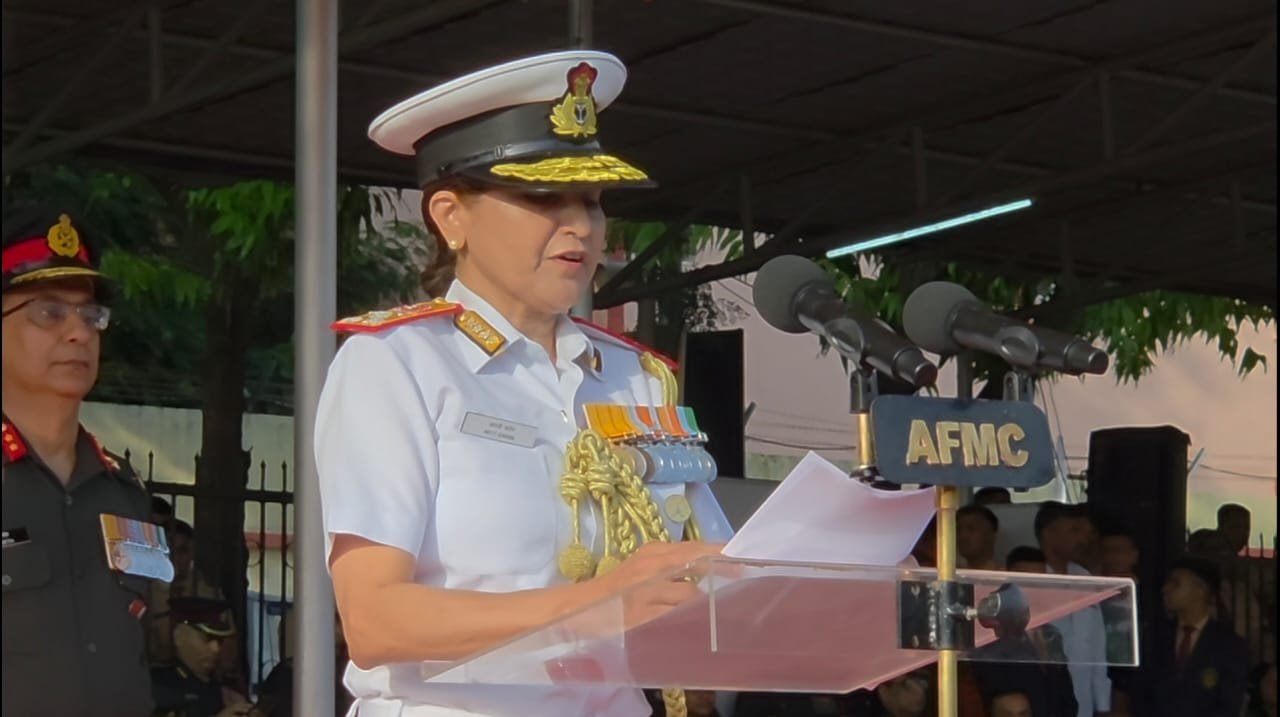
As modern warfare evolves to encompass chemical, biological, radiological, nuclear and explosive (CBRNE) threats alongside emerging technologies, the Armed Forces Medical Services (AFMS) is strengthening its preparedness through specialised training, research collaborations and advanced medical capabilities, said Surgeon Vice Admiral Arti Sarin, Director General Armed Forces Medical Services (DGAFMS).
Speaking to reporters on the sidelines of the 60th commissioning ceremony of the Armed Forces Medical College (AFMC) in Pune, where 140 medical cadets were commissioned into the Armed Forces Medical Services, Sarin outlined the military's roadmap for building a future-ready medical force equipped to respond to complex battlefield and humanitarian challenges.
Sarin said the AFMS has adopted a comprehensive approach to CBRNE preparedness, ensuring personnel across the medical services are trained to respond effectively to such emergencies.
"We are very vigilant about CBRNE threats. As an entire corps, we are training medical officers, nursing officers, nursing assistants and even non-technical personnel on how to deal with these situations," she said.
She added that CBRNE training now begins at the undergraduate level in military medical education. Earlier this year, AFMC conducted a comprehensive demonstration in which cadets were trained in handling CBRNE scenarios.
The AFMS is also conducting certified courses in collaboration with the Defence Research and Development Organisation (DRDO) and the Defence Institute of Advanced Technology (DIAT), Pune. In addition, military medical experts are extending their expertise to civilian institutions, including the All India Institute of Medical Sciences (AIIMS), with a recent training programme conducted at AIIMS Gorakhpur.
Highlighting the Armed Forces' contribution to India's human spaceflight programme, Sarin said the Institute of Aerospace Medicine (IAM) in Bengaluru, under the Indian Air Force, is responsible for the health and medical management of astronauts for the Gaganyaan mission.
The institute is conducting research in aviation psychology, space radiation biology and other aspects of aerospace medicine in collaboration with the Indian Council of Medical Research (ICMR), while ensuring the medical readiness of astronaut candidates.
Regarding international cooperation, she said that one of the Army's doctors, Major Swati, accompanied astronaut-designate Wing Commander Shubhanshu Shukla during his visit to the United States. Sarin also noted that India is the only country in the world to offer a three-year MD programme in Aerospace Medicine, underscoring the country's leadership in the field.
The DGAFMS also highlighted the Armed Forces Medical Services' longstanding contribution to humanitarian assistance and disaster relief (HADR) operations through the 60 Para Field Hospital, which continues to serve as India's rapid-response medical unit during national and international crises.
She said the unit has built an exemplary operational record since its deployment during the Korean War in the 1950s and has participated in several major relief missions, including Operation Dost in Türkiye, Operation Brahma in Myanmar, relief operations in Sri Lanka, and its latest humanitarian deployment in Venezuela.
"The 60 Para Field Hospital is always prepared. We can deploy the entire unit or individual sections depending on operational requirements, allowing us to respond quickly to emergencies anywhere," she said.
On the adoption of emerging technologies, Sarin said artificial intelligence is becoming an integral part of military healthcare as the AFMS seeks to deliver world-class treatment in peace stations while ensuring effective medical support in remote operational environments.
She said AFMS hospitals are equipped with state-of-the-art medical technologies to serve serving personnel, veterans, and their dependants, while simultaneously developing compact, portable medical systems for deployment in field hospitals to provide point-of-care treatment and prolonged casualty care under challenging battlefield conditions.
Supporting her remarks, the Dean of AFMC said the college has established an Advanced Centre of Computational Medicine and is actively pursuing AI-based medical research in collaboration with leading engineering institutions.
"We are very actively working on AI. Research projects are underway across multiple specialities, and AI has become a key area of discussion in our continuing medical education programmes. This is the future of healthcare, and we are committed to taking it forward," the Dean said.