As healthcare systems rapidly adopt digital technologies from interoperable hospital information systems to AI-driven analytics, the need for leaders who understand both technology and clinical realities has never been greater. Over the past two decades, digital health has evolved from basic hospital IT systems to complex, data-driven ecosystems, creating new opportunities for innovation and leadership within the sector.
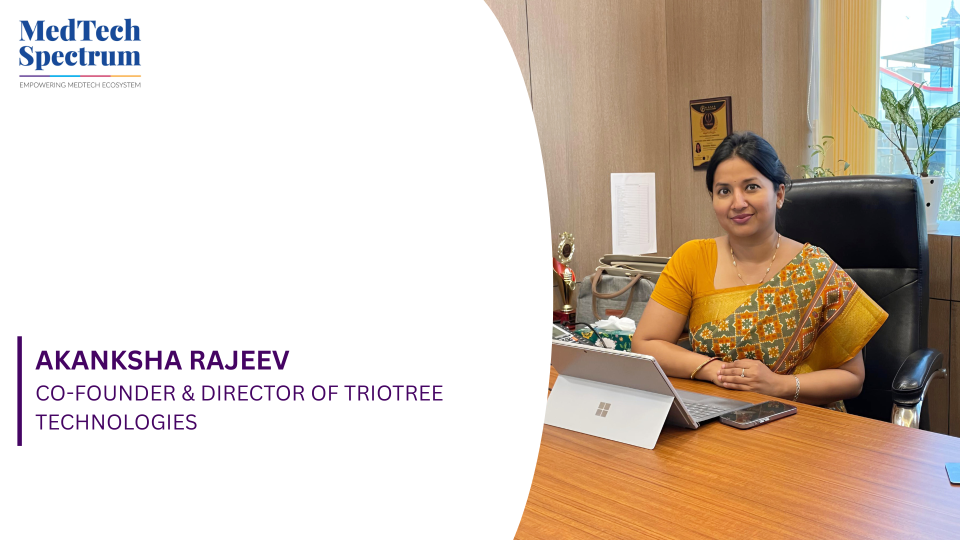
Akanksha Rajeev, Co-Founder and Client Executive at TrioTree Technologies, has been closely involved in this transformation. With more than 20 years of experience in healthcare IT, she has contributed to major hospital information system (HIS) implementations, interoperability initiatives and national digital health programs in India. Her work has also included contributions aligned with the Metadata and Data Standards Framework (MDDS) under the Ministry of Health and Family Welfare, aimed at strengthening standardisation and data exchange in healthcare systems.
In an interaction with MedTech Spectrum, Rajeev reflects on the evolving role of women in healthcare technology, the barriers that still exist in a traditionally male-dominated sector, and how inclusive leadership can drive meaningful innovation in complex healthcare environments. She also shares her perspective on the growing role of AI and analytics in healthcare and why maintaining a patient-centric and ethical approach will be critical as digital health continues to scale globally.
With over two decades in healthcare IT, how have you seen women’s roles evolve in driving digital transformation across hospitals and healthcare systems in India and globally?
When I began my career, women in healthcare IT were usually behind the scenes documentation, testing, coordination. Strategy rooms were rarely open to us. Over the years, that has changed in a very real way. Today, women are not just part of digital transformation; they’re driving it. I’ve seen women lead national health informatics programs, head large EHR implementations, and contribute at policy levels that once felt out of reach. In India especially, government-led digital health initiatives have opened meaningful doors. There’s still progress to be made, but the direction is genuinely encouraging.
Healthcare technology remains largely male-dominated. What barriers did you encounter, and what helped you establish leadership?
The barriers were subtle but persistent, being interrupted in technical discussions, having my expertise questioned, or being quietly steered toward project management as if that were the limit. What helped me move past those moments was depth. I invested heavily in specialization HL7, hospital information systems, and interoperability, so my contribution became undeniable. I also focused on building strong cross-functional relationships, not just within technical teams. Co- founding TrioTree gave me the space to lead authentically and prove that leadership doesn’t need permission when it’s backed by impact.
You’ve contributed to national initiatives like the MDDS framework and large-scale HIS implementations. How can women leaders influence policy and governance at scale?
Working on the MDDS framework with the Ministry of Health reinforced something important for me: standards aren’t just technical guidelines; they reflect priorities and values. Women often bring a grounded perspective to these discussions, shaped by real-world implementation experience. During Haryana’s HMIS rollout across 55 public health facilities, success came not only from technology, but from understanding how people actually work. Women leaders who’ve been close to the ground carry that insight into policy spaces, and that’s exactly what strong digital health governance needs.
As AI and analytics grow in healthcare, what role can women technologists play in keeping these systems patient-centric and ethical?
AI in healthcare is powerful, but it demands responsibility. We have to keep asking who this helps, and who it might leave out. Women technologists, particularly those who’ve worked closely with clinicians and operations teams, tend to ask these questions instinctively. We understand the gap between what systems can do and what care environments truly need. As analytics and AI become more common, ensuring representative data, ethical design, and workflow sensitivity will be critical. Keeping humanity at the centre isn’t optional; it’s essential.
How does inclusive leadership impact innovation in complex healthcare environments?
Healthcare technology is deeply human. It’s never just about software; it’s about people, processes, and trust. Some of the best solutions I’ve seen come from teams where diverse perspectives are genuinely valued. Inclusive leadership allows problems to be understood more fully before solutions are designed. At TrioTree, blending clinical insight with engineering capability has helped us build systems that are not only innovative but also adopted.
Inclusion isn’t a soft concept; it’s a practical design advantage.
On International Women’s Day, what advice would you give to young women entering health tech and digital health entrepreneurship?
To every young woman eyeing health tech - this space is yours, and the timing couldn’t be better. Develop depth before breadth. Whether it’s data standards, AI validation, or health system design, deep expertise creates confidence that speaks for itself. Don’t wait for an invitation if needed; create your own space. Entrepreneurship taught me that impact matters more than labels. Seek mentors who challenge you, not just those who encourage you. And on difficult days, remember this: every system you help improve, every implementation that enhances patient care that’s lasting impact. Your ambition belongs here. Dream big, start small, stay consistent—and remember, the future of healthcare is being built right now, and you deserve a seat at that table.