As healthcare systems continue to grapple with mounting documentation burdens and clinician burnout, artificial intelligence is emerging as a critical enabler of efficiency and accuracy, particularly in post-acute care settings. Companies are increasingly focusing on embedding AI directly into clinical workflows to ensure seamless adoption without disrupting care delivery.
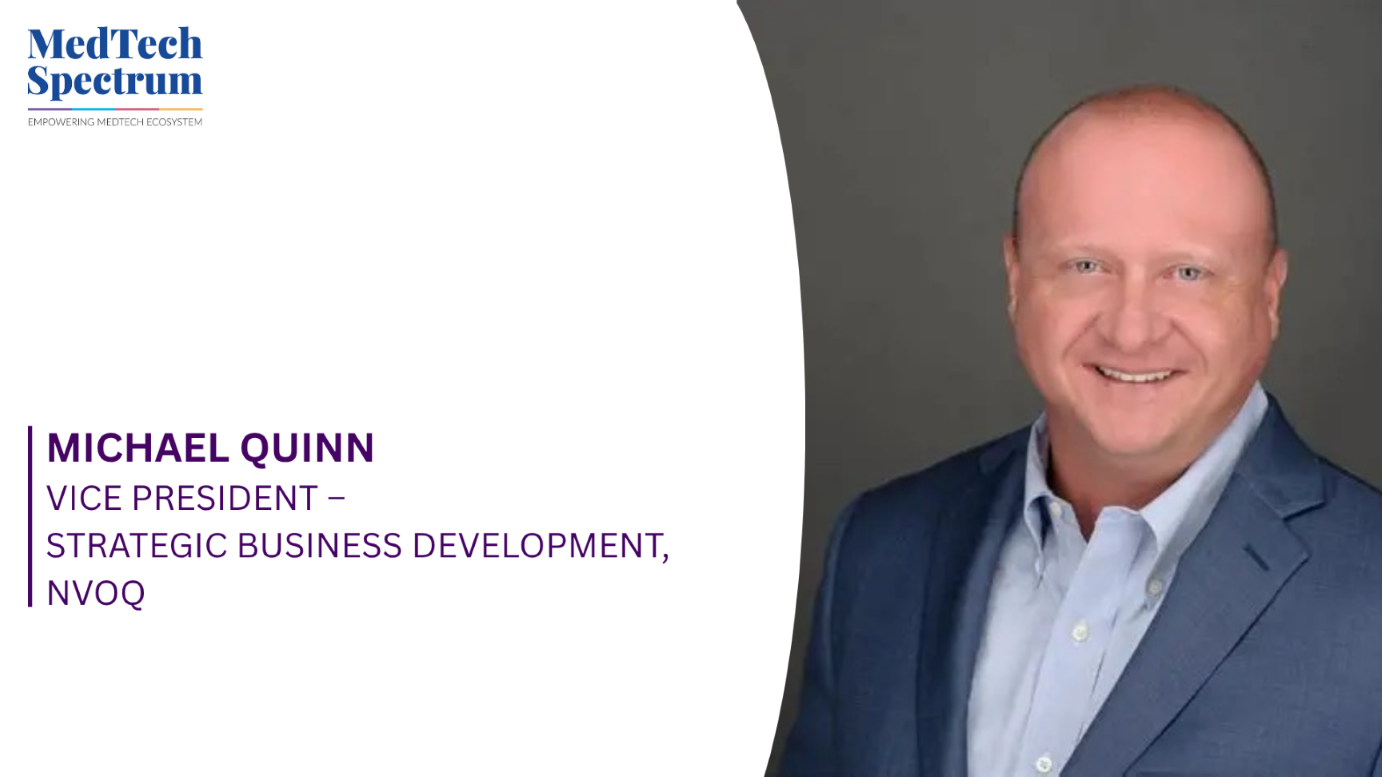
In this interview with MedTech Spectrum, Michael Quinn, Vice President – Strategic Business Development at nVoq, discusses the company’s integration with MatrixCare and how its ambient AI-powered voice solutions are transforming clinical documentation in home health and hospice environments. He shares insights on responsible AI deployment, the challenges of speech recognition in complex care settings, and how nVoq is shaping the future of real-time, compliant documentation at the point of care.
What strategic objectives underpin your integration with MatrixCare, and how does this partnership enhance AI adoption in post-acute care settings?
Post-acute care has some of the most demanding documentation requirements in healthcare, including complex care plans and tight compliance timelines. Clinicians have been absorbing that burden manually for too long. Our work with MatrixCare is rooted in a shared belief that the right technology, built into the tools clinicians already use, can change that.
nVoq Voice, powered by ClinicalCore AI, was built and field-validated specifically in post-acute environments. MatrixCare brings one of the most trusted EHR platforms in home health and hospice. By working together, we're putting clinical documentation capabilities directly inside the workflows providers depend on every day. As a result, adoption happens naturally rather than as a separate step.
Your solution emphasises “responsible AI.” How does nVoq ensure accuracy, compliance, and clinician oversight in AI-generated documentation?
Responsible AI, for us, means the clinical team never loses control of the documentation. The AI supports their judgment, but it doesn't replace it. It all starts with how we build our models: PhD-level data scientists work alongside post-acute clinicians to develop and evaluate every workflow on real clinical language, not generic training data.
From there, we maintain what we call an "Expert in the Loop" approach. Model updates, governance alignment, and performance improvements are fully managed by our clinical AI team. Our partners don't carry that compliance burden internally, and clinicians can trust what they're reviewing and signing off on.
How does your ambient AI technology differentiate itself from other clinical documentation tools currently on the market?
Most documentation tools are built for acute care and adapted for post-acute settings. We built ClinicalCore AI from the ground up for this space. The clinical language, regulatory forms, and workflows are different. That depth of specialisation matters when you're dealing with something as structured and auditable as an OASIS assessment.
We also offer a phased path into voice-enabled documentation that others in the space don't. That starts with plain voice-to-text — a familiar, low-barrier entry point for clinicians who haven't worked extensively with voice tools before. Clinicians can build confidence and partners never have to rebuild or reopen compliance review as their customers grow into more advanced capabilities.
In what ways does integrating ClinicalCore AI within MatrixCare improve workflow efficiency and reduce administrative burdens for home health and hospice providers?
Clinicians in home health and hospice spend a significant portion of their time after visits finishing documentation. That’s time that comes directly out of patient care and personal capacity. nVoq Voice, powered by ClinicalCore AI, works within MatrixCare to capture clinical information in real time, reducing the documentation work that happens after the fact.
The structured understanding of regulated forms like OASIS means clinicians aren't just dictating notes. The AI language model understands the clinical context well enough to support accurate, compliant documentation. Fewer corrections and more complete records have a real downstream impact — faster claims processing, improved cash flow, and better Star ratings for home health agencies. When clinicians have the right tools to document accurately and thoroughly at the point of care, the benefits ripple across billing, quality reporting, and patient outcomes.
What challenges did you encounter in deploying AI-driven speech recognition within complex post-acute care environments, and how were they addressed?
Post-acute care is a genuinely complex speech-recognition territory. Clinicians work in patients' homes, in variable acoustic environments, across a wide range of accents and documentation styles, and under regulatory requirements that don't leave room for error. Generic speech models struggle in those conditions.
Our approach was to train AI specifically on post-acute clinical language and to incorporate real-world clinician feedback into our development process. It's not a one-time effort; it's ongoing. That's why we manage model performance and updates continuously rather than pushing that work onto our partners.
We also recognised early on that speech-to-text is new territory for many clinicians. So beyond the technology itself, we built a growth path that lets clinicians start with plain voice-to-text and move into more advanced capabilities as their comfort and confidence grow. That step-by-step approach has been meaningful for adoption — clinicians who ease into the change are far more likely to stick with it and get the full benefit over time.
How do you see ambient AI and voice-enabled documentation evolving in healthcare, and what role will nVoq Inc. play in this transformation?
The direction is clear: documentation that happens during care, not after it, captured in the clinician's own words and structured automatically for compliance. That's a better way of working for clinicians, patients, and the care teams reviewing those records downstream.
What's less clear for many organisations is how to get there reliably and responsibly. nVoq's role is to make that path practical by giving EHR and care management platforms a foundation they can build on quickly, without taking on the AI development and governance burden themselves. The partnership with MatrixCare is a strong example of what that looks like in practice, and we expect to deepen that kind of work across the post-acute ecosystem.