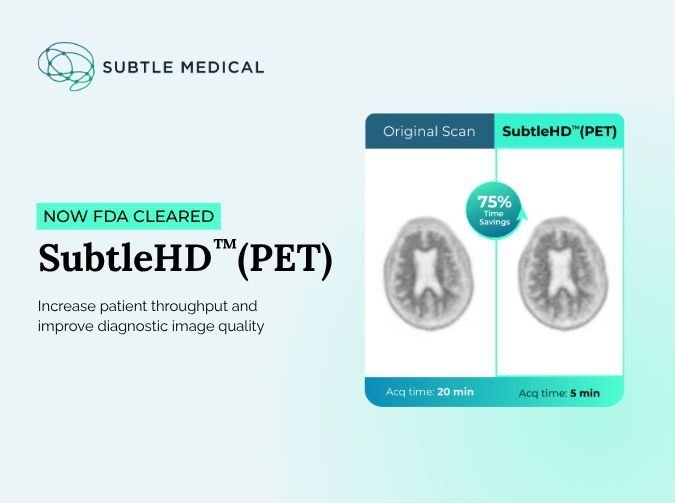
Subtle Medical has received US FDA clearance for SubtleHD(PET), its next-generation AI-powered PET image acceleration and enhancement software.
The clearance addresses a growing capacity challenge in nuclear medicine. PET imaging volumes are expected to rise as new radiotracers, theranostic workflows and oncology applications expand, placing pressure on scanner availability, appointment access and imaging centre throughput.
SubtleHD(PET) is designed to improve PET image quality while enabling faster imaging workflows across PET/CT and PET/MR systems. The company states that the software can support up to 75 percent faster PET imaging on existing scanners, allowing providers to increase efficiency without purchasing new hardware.
The solution supports all FDA-approved radiotracers, expanding its relevance beyond traditional 18F-FDG imaging into advanced molecular imaging and theranostic programmes. This compatibility is important as health systems adopt newer tracers and require tools that can standardise imaging quality across different clinical applications.
SubtleHD(PET) uses AI image enhancement to support accelerated low-count PET acquisitions, improve quantitative consistency and provide greater SUVmax quantitation accuracy. The software also uses anatomical CT data to further enhance PET reconstruction quality and allows denoising levels to be adjusted according to radiologist preference.
The market need is significant, with an estimated 4.5 million PET scans performed globally each year. Industry reports cited by the company indicate that 67 percent of PET imaging sites expect procedure volumes to increase over the next 12 months.
For patients, shorter PET exams may reduce discomfort, particularly among oncology, elderly, paediatric and critically ill populations who may find longer scans difficult. For imaging providers, shorter scan times can support additional appointment capacity and improve utilisation of existing PET infrastructure.
SubtleHD(PET) forms part of Subtle Medical’s wider multi-modality AI imaging portfolio across MRI, PET and CT. The company reports that its solutions are deployed on more than 1,300 scanners worldwide, positioning the platform around enterprise-scale imaging workflow optimisation.
Adoption will depend on clinical confidence in image quality, integration with existing scanner and PACS workflows, reimbursement dynamics and radiologist acceptance of AI-enhanced reconstruction. As imaging demand continues to rise, AI tools that improve throughput without requiring new capital equipment may become increasingly important to healthcare system efficiency.