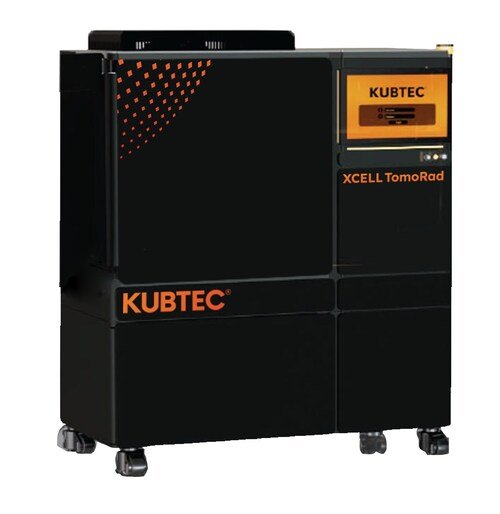
KUBTEC Scientific has launched the XCELL TomoRad system, a new x-ray irradiator designed to support image-guided radiotherapy research in preclinical cancer studies.
The system was introduced at the annual meeting of the American Association for Cancer Research. KUBTEC said the launch creates a new category of image-guided radiotherapy systems for researchers seeking more targeted radiation delivery in animal studies.
Preclinical radiotherapy research often requires precise targeting, repeatable dosing and imaging workflows that can support translational cancer studies. However, access to image-guided radiotherapy systems has traditionally been limited by high equipment costs, difficult installation requirements and operational complexity.
The XCELL TomoRad system incorporates tomosynthesis, a 3D imaging technique that uses multiple x-ray images taken from different angles to reconstruct a three-dimensional image of the target. The image can be viewed in 1 mm slices, providing researchers with anatomical guidance for treatment planning and targeted irradiation.
Compared with microCT imaging, KUBTEC said tomosynthesis offers lower sample radiation exposure, faster image acquisition and reconstruction, faster dosing and lower cost. These factors may be important for laboratories that need to balance imaging precision with throughput, study reproducibility and animal welfare considerations.
The system also includes Advanced Treatment Planning software as a standard feature, supporting accurate, customisable and repeatable targeted radiation dosing. This is intended to reduce the technical burden for research teams that may not have access to more complex or expensive radiotherapy research platforms.
KUBTEC also highlighted Mag Mode, a patent-pending ultra-fast dose delivery method that automatically positions the sample near the tube to deliver the highest dose in the shortest time. According to the company, the approach is designed to reduce treatment time without requiring the space and expense of a proton beam generator.
For busy research laboratories, faster image acquisition and treatment delivery could help reduce time under anaesthesia and associated stress for animals. This supports more efficient study workflows while improving the practical feasibility of targeted irradiation protocols.