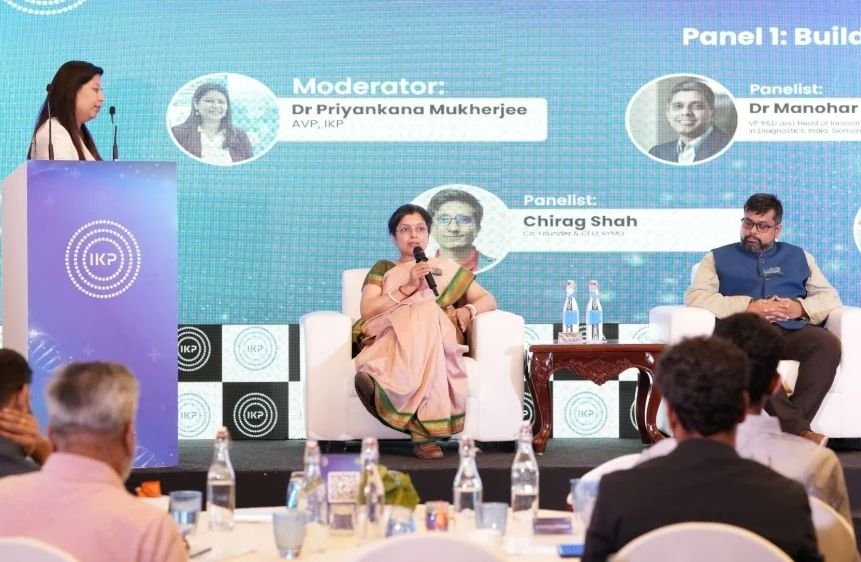
The panel discussion on “Building & Scaling MedTech Companies”, held on April 1, 2026, in Bengaluru as part of the MedTech workshop titled “MedTech Scale-up Blueprint: A View from the Trenches” organised by IKP Knowledge Park, brought together a diverse group of founders and ecosystem leaders who shared nuanced, experience-driven insights into MedTech entrepreneurship, with a strong focus on founder journeys, go-to-market (GTM) strategies, and revenue generation.
The session was moderated by Dr Priyankana Mukherjee, AVP & Head, BioNEST, IKP Knowledge Park, and featured an accomplished panel comprising Ravi Kiran Manapuram, Founder & Managing Director, MedevPlus; Chirag Shah, Co-Founder & CEO, Rymo; Varun AV, CTO & Co-Founder, Inito; Dr Shantanu Pathak, Founder, CareMother (Doto Health); and Dr Sanchita Chaudhary, Program Director – MedTech Acceleration, Blockchain for Impact (BFI).
The discussion began with founders reflecting on their journeys, emphasising that impactful MedTech innovations are rooted in firsthand exposure to unmet clinical needs. Ravi Kiran Manapuram highlighted how his experience at Leica Microsystems revealed a gap in access to affordable ophthalmic technologies, inspiring him to build cost-effective solutions for wider adoption. Chirag Shah spoke about the limited accessibility of robotic rehabilitation systems, which led him to develop scalable physiotherapy technologies, while Varun AV shared how his stint at Siemens exposed the lack of decentralised diagnostics, leading to Inito’s home-based fertility monitoring platform. Dr Shantanu Pathak brought in a public health perspective, focusing on maternal and neonatal care, where early monitoring can significantly improve outcomes.
A major part of the discussion centred on GTM strategies and revenue generation, where the panellists candidly addressed the complexities of commercialising MedTech innovations. Chirag Shah emphasised that true market validation begins when customers are willing to pay, urging startups to prioritise early revenue even at the prototype stage. Varun AV elaborated on the limitations of traditional clinician-led distribution models, which are often slow and fragmented, and shared how Inito successfully pivoted to a direct-to-consumer approach using digital platforms, enabling faster adoption and continuous user feedback. He also cautioned against blindly replicating aggressive growth models like that of Flipkart, noting that such strategies require strong fundraising capabilities and must align with a startup’s inherent strengths.
Dr Shantanu Pathak highlighted the importance of region-specific GTM strategies within India, pointing out that market dynamics differ significantly across geographies, and advised startups to begin with regions that offer quicker adoption before scaling further. From a revenue standpoint, the panel discussed hybrid models combining device sales with recurring income streams, institutional sales through hospitals and public health systems, and the growing relevance of D2C models in certain segments. They also acknowledged the critical role of grants and non-dilutive funding in sustaining MedTech startups through long development and regulatory cycles.
Dr. Sanchita Chaudhary provided a systemic perspective on common failure points, stressing that many startups begin with technology and attempt to retrofit it into healthcare settings, rather than starting with a clearly defined problem. She emphasised that clinical validation is essential for both adoption and revenue, as clinicians act as key gatekeepers, and highlighted the importance of designing solutions that integrate seamlessly into existing workflows without adding to the burden of healthcare providers. She also outlined the role of Blockchain for Impact as an ecosystem enabler, facilitating collaboration across stakeholders and supporting startups through structured programs such as NAMA, which provide funding, infrastructure, and regulatory guidance to de-risk innovation. The discussion also addressed operational realities such as supply chain dependencies on global components, regulatory complexities across markets, and the lingering impact of the COVID-19 pandemic, which, while disruptive, also accelerated innovation and adaptability.
In conclusion, the panel underscored that building and scaling MedTech companies requires a careful balance of innovation, validation, and execution. Founders must ground their solutions in real clinical needs, adopt flexible and context-driven GTM strategies, and develop sustainable revenue models while navigating regulatory and operational challenges. The insights shared by the panellists collectively reinforced that success in MedTech is not defined by technology alone, but by the ability to align products with market realities, engage stakeholders effectively, and scale thoughtfully across diverse healthcare ecosystems.