As healthcare systems across Southeast Asia accelerate their digital transformation journeys, the focus is increasingly shifting from episodic treatment toward connected, continuous, and patient-centric care models. Technologies such as telehealth, AI, predictive analytics, interoperable health data platforms, and remote monitoring are redefining how healthcare is delivered, coordinated, and experienced beyond the traditional hospital setting.
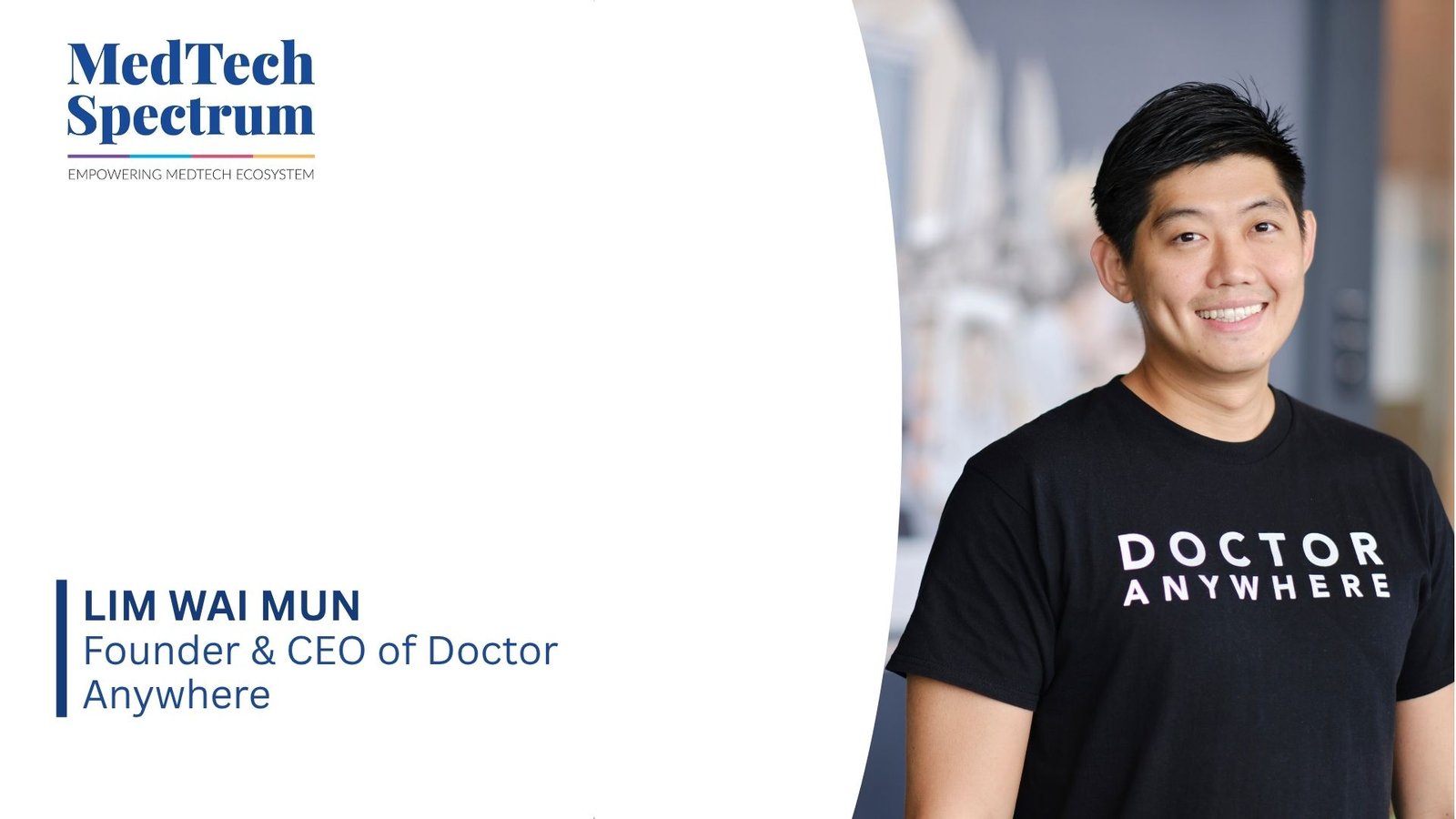
In this interview with MedTech Spectrum, Lim Wai Mun, Founder & CEO of Doctor Anywhere, Singapore, shares his perspectives on the evolution of virtual-first healthcare, the growing importance of integrated digital care ecosystems, and the role of intelligent technologies in improving accessibility, operational efficiency, and patient outcomes across the region. He also discusses how Doctor Anywhere is building a unified healthcare platform designed to support seamless care continuity while addressing the diverse healthcare realities of Southeast Asian markets.
Doctor Anywhere advocates for a connected continuum of care. How do you see the role of hospitals evolving beyond traditional physical infrastructure to become part of a more integrated, digital-first healthcare ecosystem?
Healthcare is fundamentally a service industry, but it's long been designed like a destination. You go somewhere to receive care. That's changing - not because hospitals are becoming less important, but because technology now allows the quality and expertise they represent to extend far beyond their physical footprint.
The most forward-thinking health systems are already asking: what does continuous care look like? Not episodic, not reactive, but genuinely ongoing. Digital-first doesn't mean screen-first - it means designing the patient experience around their life, not around institutional infrastructure. At Doctor Anywhere, that's the model we're building and refining every day, across five connected stages of care - preventive, primary, specialist, hospital and step-down. Hospitals are essential partners in that - the question is how the whole system fits together around the patient.
Virtual-first care has gained significant momentum across Southeast Asia. In your view, what are the biggest opportunities and challenges in making continuous, accessible healthcare a sustainable reality across the region?
Operating across the region has taught us that the opportunity is real but never uniform. Each market has its own starting point - different infrastructure, different regulations, different cultural expectations around healthcare, different ways people access and pay for it. That diversity is both the challenge and the insight.
The opportunity lies in reaching and engaging people through channels they already trust. In the Philippines, HMOs. In Singapore, employers and insurers. Virtual-first care scales when it's distributed through existing relationships, not when it asks people to adopt entirely new behaviours from scratch.
The challenge is resisting the temptation to copy-paste. What works in one market rarely transplants cleanly into another. Sustainable access requires designing for each community's actual reality - which means genuine local presence, not just a localised interface. Every market we've entered has required us to relearn healthcare from the ground up. That discipline is what makes the difference between a platform that launches and one that lasts.
Healthcare delivery often remains fragmented across providers and care settings. How can unified digital platforms help bridge these gaps and improve care coordination, operational efficiency, and patient outcomes?
The fragmentation problem in healthcare isn't new, but the consequences are becoming harder to ignore as populations age and chronic disease burden rises. When care is siloed, patients fall through the gaps - not because providers don't care, but because the system wasn't designed with continuity in mind.
A unified platform changes the underlying logic. Instead of each touchpoint operating independently, there's a shared view of the patient, a shared record of what's happened, and a shared responsibility for what comes next. That's what we've built with DA - not a collection of health services, but a single, unified experience that holds the patient's journey together. The operational benefits follow naturally: less duplication, faster handoffs, better-informed decisions at every step.
Data continuity is increasingly critical to connected care. How is Doctor Anywhere leveraging interoperable health data and digital integration to enable faster, more informed clinical decision-making?
The honest answer is that interoperability is less a technology problem today than a design and trust problem. The tools exist. What's harder is building systems that clinicians actually use consistently, that patients trust enough to share through, and that produce data clean enough to be actionable.
Our approach has been to solve for the architecture first - building Vantage, our TPA platform, with a flexible backend designed for exactly this complexity - before layering intelligence on top. AI is only as useful as the data it works with, and healthcare data is notoriously messy. Designing for that reality, rather than assuming clean inputs, is what makes the difference between a system that works in a demo and one that works in practice.
As healthcare systems work toward building ‘intelligent hospitals,’ what role do technologies such as AI, telehealth, predictive analytics, and remote monitoring play in shaping the future of scalable care delivery?
These technologies matter most when they're invisible to the patient - when care simply feels more responsive, more joined-up, more human. That's the bar we hold ourselves to. At DA, AI runs through our operations in ways that are practical and immediate: supporting clinical triage, powering claims adjudication and fraud detection through Vantage, enabling round-the-clock multilingual service through DA Genius. Remote monitoring and telehealth extend the moments of care beyond the consultation itself. Predictive analytics lets us act on population health patterns before they become individual crises. None of these is a standalone feature - they're parts of a system designed to function as one. The technology is in service of a simpler goal: ensuring the right care reaches the right person at the right time.
Looking ahead, what are Doctor Anywhere’s strategic priorities for advancing connected healthcare across Southeast Asia, and how do you envision the region’s digital health landscape evolving over the next five years?
We want DA to be where people start when something feels off - or when they're simply trying to stay well. The way someone might search for information instinctively, we want people to think of DA first for anything health-related: finding a doctor, understanding a diagnosis, managing a chronic condition, or just knowing whether a symptom warrants attention. That trusted, always-accessible first touchpoint is the foundation on which everything else is built.
From there, the priorities are integration and depth - ensuring that the first touchpoint connects seamlessly to whatever comes next, whether that's a teleconsult, a specialist referral, a prescription, or an in-person visit. Regionally, that means continuing to build with genuine local understanding rather than applying a single template across very different markets. The next five years will see AI accelerate what's possible significantly.
As the region's digital health ecosystem continues to evolve, platforms such as ATxEnterprise will remain important convening points for healthcare leaders, policymakers, and technology innovators to exchange ideas, foster collaboration, and shape the future of connected and AI-enabled healthcare across the region.
Ultimately, the companies that lead won't be the ones with the most technology - they'll be the ones that deploy it with the most judgment.