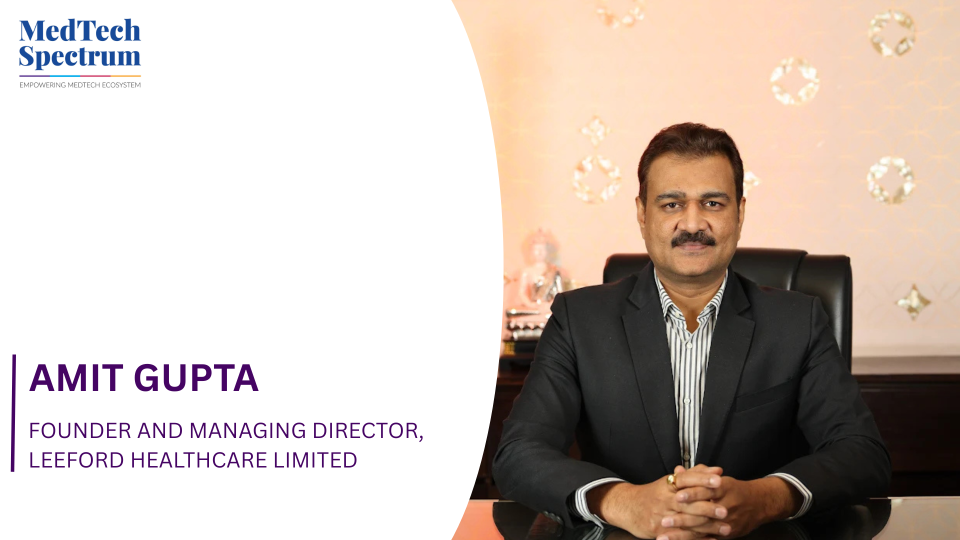
India’s pharmaceutical sector has undergone rapid transformation over the past two decades, driven by evolving regulatory frameworks, rising competition, and increasing demand for affordable yet high-quality healthcare solutions. Companies that began as modest ventures are now navigating complex global markets by embracing innovation, diversification, and technology-driven manufacturing. Among them, Leeford Healthcare Limited has steadily expanded its footprint across multiple therapeutic segments while maintaining a strong focus on affordability and accessibility. In this interview with MedTech Spectrum, Amit Gupta, Founder and Managing Director of Leeford Healthcare Limited, discusses the strategic decisions that have shaped the company’s growth, how it navigates regulatory and market challenges, and the role of innovation, diversification, and frugal technologies in advancing accessible healthcare.
Defining Strategic Decisions that enabled the company to evolve from a modest startup into a diversified Pharmaceutical organisation?
Strategic decisions are high-stakes, long-term choices that define a company’s direction, allocate critical resources, and foster evolution. These decisions (e.g., segments to enter, adopting new methodologies/technology) align organisational goals with market trends, driving competitive advantage and ensuring survival through adaptability. As a result, it is critical for corporate leaders to always try to improve their analytical talents, nurture creative thinking and create resilience and flexibility in order to make effective strategic decisions. Overall, flexibility and agility are critical components of effective leadership in today's rapidly changing business context.
Our defining strategic decisions that shaped our evolution are -
Long-term focus: Right from the inception our focus was on quality & prioritizing sustained growth over immediate, short-term gains.
Product/Service Innovation: Investing in research and development to create new offerings that meet changing customer preferences. Offering complete range of products in a given segment, instead of one or two top selling, leading to holistic offerings that build trust & satisfied needs of our partners.
Business Model Transformation: Shifting from traditional generic sales model which was margin driven from distributors to team based model that drive business for company and partners based on newer developments and platforms to stay relevant & ahead of competition.
Market Expansion & Diversification: Choosing to enter new geographical areas or customer segments to drive sustained growth, constantly.
Resource Allocation: Shifting capital, technology and talent toward high-priority, high-growth areas that fueled organization growth and its aspirations.
Data-Driven Insights: Utilizing market research and internal performance metrics rather than guesswork.
Risk Management: Proactively navigating uncertainty by assessing potential threats and opportunities using advance business matrix.
Cross-Functional Alignment: Ensuring that HR policies, marketing and finance departments are aligned with the changing directions and are totally in sync with policies to drive organizational growth.
These strategic decisions are not one-time events but an iterative process of evaluation, implementation and adaptation to the business environment that has significantly contributed to Leeford’s growth.
How did Leeford navigate industry upheavals while maintaining growth & affordability?
Navigating the ever changing pharmaceutical landscape requires a shift from reactive compliance to proactive and value-based strategies. Using various differentiating and innovative operational and product offerings we need to differentiate in a competitive market to have an edge above others. Key approaches includes –
Navigating Regulatory Shifts:
Adopting "Quality by Design" (QbD) to manage strict regulations that facilitates compliance by establishing a "design space" of critical material attributes (CMAs) and process parameters (CPPs) to ensure consistent, high-quality and flexible manufacturing. It integrates quality assurance early into the manufacturing process rather than just testing at the end, which reduces deviations and costs.
Investing in digital compliance platforms & automation: By implementing software for audit trails and automated electronic batch records (EBRs), to enhance traceability and reduce human error are the other key factors.
Addressing Pricing Pressures:
With governments pushing for lower drug prices and patent expirations, pharma companies must pivot toward demonstrating the economic value of their products by adopting Value-Based Pricing (VBP). Utilizing value-based pricing and real-world evidence (RWE) to counter cost pressures & price control on drugs by government, by shifting the focus from the volume of services to the actual clinical outcomes delivered. Real-World Evidence (RWE) uses data from patient health records and registries to demonstrate long-term safety and efficacy to payers.
Optimizing Portfolio Management: Diversifying into niche therapies or specialty medicines that offer higher margins and less competition than mature markets or older molecules is the key.
Managing Rising Competition
To compete effectively, we have shifted toward faster innovations, Formulation &Development(F&D) and improved customer engagement through teams. By building resilient supply chains we shift from a single-source distribution model to a diversified, regionalized supply network to avoid shortages & using block chain technologies to increase transparency. By optimizing & enhancing omni-channel commercialization, using digital platforms for personalized engagement, we are moving away from traditional, infrequent sales visits to a distinctive & differentiating model.
|
Challenge |
Key Strategy |
|
Regulatory |
Adopting "Quality by Design", Digital platforms & automated EBRs |
|
Pricing |
Value-based pricing, Real-World Evidence (RWE) analytics & Portfolio diversification |
|
Competition |
F&D, Improved Customer Engagement models & Diversified supply network |
What was the strategic thinking behind this diversification & how do we ensure quality and regulatory compliance across such varied verticals?
Strategic thinking behind diversification involves moving beyond a company's current products or markets to foster growth, reduce risk and enhance long-term sustainability. We at Leeford believed strongly in diversification guided by our vision & long term focus to beat market saturation, to utilize our increasing revenue, to enter into more attractive and profitable segments of industry & to grow with high-growing segments of the pharmaceutical industry. We have utilized various different diversification strategies that encompass Related or Concentric Diversification, Horizontal Diversification & trying for Vertical Diversification (Integration).
Key strategic drivers for our diversification:
Risk Mitigation - By expanding into different segments we reduce our dependence on a single segment, thereby softening the impact of industry-specific downturns.
Growth and Revenue Generation - When markets become saturated, diversification is the only tool that provides new avenues for top-line growth.
Leveraging Core Competencies - We moved into "related" categories so that we can apply existing technical know-how or marketing expertise to gain a competitive advantage.
Achieving Synergy (Economies of Scope) - By adopting this, our goal is to make the combined business stronger than the individual segments by sharing resources, skill, knowledge and distribution channels.
Defensive Positioning - We take it as a proactive response to unavoidable industry decline, acting as a "turnaround" strategy to prevent corporate damage.
Leeford’s F&D division focuses on both product & process innovation. Elaborate on how innovation in process engineering & NDDS are strengthening accessibility, safety & cost efficiency?
Innovations in process engineering and formulations are fundamentally transforming manufacturing, particularly in the pharmaceutical sector by shifting from traditional, rigid, and resource-intensive methods to agile, automated and precision-driven systems. These advances, including continuous manufacturing, advance analytics and innovative drug delivery are enhancing accessibility through faster production, increasing safety through real-time quality control and maximizing cost efficiency by reducing waste and optimizing resources. Key improvements in these areas are:
Strengthening Accessibility i.e. faster and more flexible access to drugs
Strengthening Safety i.e. quality and consistency in production
Strengthening Cost Efficiency i.e. reduction of waste and resources
With ongoing research across oral solid dosages, Injectables & Topical drugs, what therapeutic areas or unmet medical needs is Leeford prioritizing as it enters its third decade?
At our F&D centers, the ongoing research across oral solid dosage (OSD), injectables and topical drugs are primarily focused on overcoming bioavailability, stability and patient compliance challenges to address chronic, high-burden and complex diseases. Key therapeutic areas we want to focus on includes Oncology, Critical care, Veterinary, Diabetes (Insulin & other injectables), autoimmune disorders, specialized Neurological conditions and Vaccines.
Oral Solid Dosage (OSD) Research & Unmet Needs
OSDs remain the preferred route due to high patient compliance, with research focused on transforming challenging molecules into oral forms. The main unmet needs addressed are –
Low Bioavailability or Solubility: Utilization of various technologies to enhance solubility of poorly soluble drugs.
"Pill Fatigue": Development of modified-release (MR) technologies to reduce dosing frequency.
Patient Compliance or Swallowing Issues: Pharmaceutical technologies are increasing being used for producing various forms to address this issue, such as rapid-disintegration tablets etc.
Targeted Delivery: Novel oral, nano-preparations are being developed for targeted delivery beyond the gastrointestinal tract, including to the brain and for inflammatory diseases.
Injectables & Advanced Delivery Research
Research is heavily driven by the surge in biologics, requiring specialized, patient-friendly, and often high-volume, high-viscosity delivery systems. The main unmet needs addressed are –
Needle-free/Painless Administration: Microneedle technology is transforming vaccine and insulin delivery.
High-Volume/Viscous Drugs: Wearable injectors and on-body delivery systems (OBDS) are replacing traditional in-person IV infusions for chronic, high-volume, subcutaneous drugs.
Targeted Therapy: Nanoparticles, liposomes, and Antibody-Drug Conjugates (ADCs) are reducing systemic toxicity by delivering potent compounds directly to diseased cells.
Adherence in Chronic Disease: Long-acting injectable antipsychotics and implants are improving treatment continuity.
Topical Drug Research
Research in this area aims to increase skin penetration and provide localized action, often reducing the side effects of systemic, oral, or injectable treatments. Key therapeutic areas are Acne, Psoriasis, Eczema, wound healing, skin infections and pain management.
How does Leeford plan to balance scale, affordability & technological advancement while reinforcing its founding vision of accessible healthcare for all?
At Leeford balancing affordability and technological advancement means shifting from a "cutting cost" mindset to "cost optimization," by focusing on high-impact, incremental innovations rather than just expensive, cutting-edge, or "shiny" tech. Achieving this balance involves a strategic approach that prioritizes value-driven, scalable and often open-source solutions to ensure accessibility without compromising on performance and affordability. Key strategies that we utilize to balance affordability and technological advancement are:
Adopt "Frugal" or "Lean" Innovation: Instead of always building or buying the newest, most expensive technology, focus on frugal innovation, which involves using existing resources to create high-value, lower-cost solutions.
Strategic Implementation: It is the critical process of converting strategic plans into organizational action to achieve long-term goals, bridging the gap between formulation and execution. It involves aligning organizational structure, culture, resources and systems (KPIs) to drive performance. We also apply the principle of first thing first.
Smart Resource & Vendor Management: It involves using technology-driven, strategic processes to oversee third-party suppliers, aiming to reduce costs, minimize risks and maximize value throughout the vendor lifecycle. It goes beyond traditional, transactional purchasing by integrating automated, AI-powered tools for on boarding, contract management, performance tracking and risk assessment.
Optimize Human and Intellectual Capital: We optimize human and intellectual capital that involves investing in employee training, fostering a culture of continuous learning and implementing robust knowledge management systems to maximize the value of collective expertise. We nurture talent through development opportunities, improving retention to prevent knowledge loss, utilizing AI for strategic workforce planning and aligning individual skills with organizational goals to drive innovation and competitive advantage.