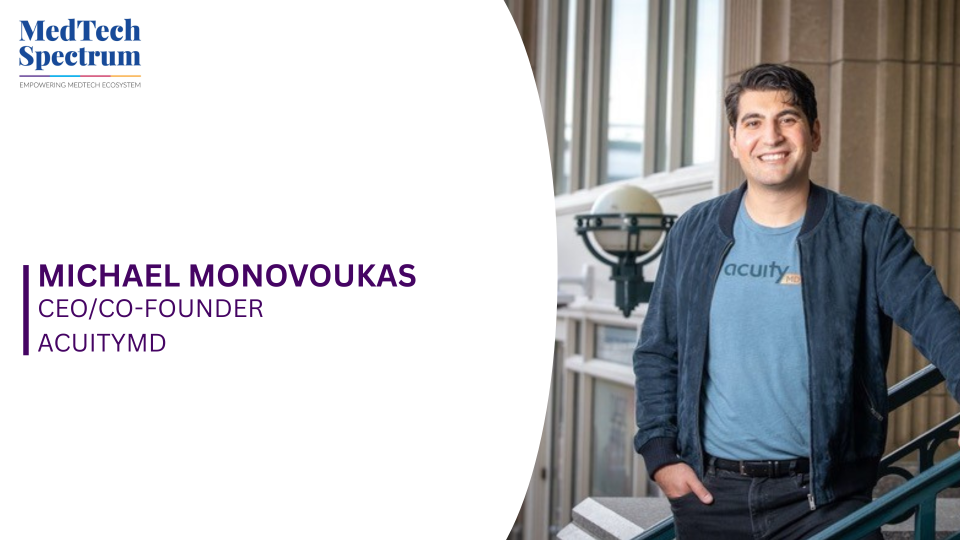
As the MedTech industry navigates growing commercial complexity driven by hospital consolidation, evolving reimbursement models, and increasingly data-driven decision-making, AI is emerging as a critical enabler of smarter, faster go-to-market strategies. At the forefront of this shift is AcuityMD, which is redefining how commercial teams access and act on healthcare data through its proprietary ontology and knowledge graph approach.
Led by CEO and Co-Founder Michael Monovoukas, the company is helping MedTech organisations move beyond fragmented datasets and static dashboards toward real-time, decision-ready intelligence. With fresh momentum from its recent $80 million Series C funding, AcuityMD is expanding its AI capabilities to serve not just sales teams, but also marketing and leadership functions, bringing a new level of precision and speed to commercial execution.
In this interview with MedTech Spectrum, Monovoukas discusses how AcuityMD is tackling one of healthcare’s toughest data challenges, the role of AI in transforming MedTech commercialisation, and what the future holds for a sector where insight, timing, and trust are increasingly interconnected.
AcuityMD has positioned its platform around a proprietary MedTech ontology and knowledge graph. How does this approach differ from traditional healthcare data platforms, and what tangible advantages does it offer MedTech commercial teams?
MedTech selling is fundamentally different from almost every other commercial activity. Sales reps sell to physicians in specific facilities, inside an Integrated Delivery Network (IDN) with a Group Purchasing Organisation (GPO) contract, against competitive dynamics that vary account by account. On top of it all, it’s often the hospital administrator who increasingly controls the buying decision.
Traditional healthcare data platforms were simply not built for this level of commercial complexity.
In contrast, AcuityMD built an ontology that reflects specifically how real-life MedTech commercial teams operate – mapping physicians, facilities, networks, contracts, procedures, reimbursement dynamics, and the relationships between all of them – aligned to each company's own territories, products, and customers.
With the new $80 million Series C funding, led by StepStone Group, what specific AI capabilities or product enhancements are you prioritising in the near term?
We initially focused on supporting sales reps, and we have made a lot of progress there already. With this funding, we are now able to address the broader commercial organisation, including sales leaders and marketing teams.
Sales leaders are typically responsible for a team of reps across a territory, trying to figure out where to allocate resources, which accounts deserve more attention, where the whitespace is, how to coach their team on the right priorities, and more. Right now, most of that is a mix of gut feel and spreadsheets. AcuityAI gives sales managers a new view of their entire region, not just a dashboard, but an AI agent that can reason across their territory, flag anomalies, surface coaching opportunities, and prioritise.
Upstream in marketing, the problem is even more stark. MedTech marketers must answer the hardest strategic questions: which markets do we invest in? Where are procedures growing and where are they declining? What does the competitive footprint look like before committing to an acquisition? Right now, marketing teams are answering those questions with a combination of static market research reports, spreadsheets, and qualitative interviews that take months to conduct. It's a really expensive, slow, and fragmented way to make critical decisions. AcuityMD can transform marketing processes.
You mention aggregating fragmented data sources such as claims, FDA filings, and reimbursement signals. How do you ensure data accuracy, interoperability, and real-time relevance across such diverse datasets?
AcuityMD’s incredible data and engineering teams have worked tirelessly to build the platform.
Uniquely, our team has built a structured knowledge graph that connects different entities across many different sources (i.e., surgeons, facilities, devices, procedures, contracts, reimbursement dynamics). We use a common identity layer as the framework to make all of this fragmented data coherent. Without that, you are just aggregating noise. Entity resolution across healthcare systems that all use different identifiers is a complex informatics problem, and this is where our team shines.
The accuracy mechanism that compounds on top of all of that is the flywheel. Nearly 500 MedTech companies run production workflows every day, generating continuous signals that validate relationships, surface errors, and reveal gaps. We also have a rich, valuable feedback loop coming back from sales reps and commercial teams, telling us what's right and what’s not.
Data quality is a continuous investment. And our team treats it that way. The field validation we see tells us we are in a really good place, and we are only getting better.
AI adoption in healthcare often faces regulatory and trust barriers. How does AcuityMD address concerns around data privacy, compliance, and the explainability of AI-driven insights?
The data we work with is commercial data, such as procedure volumes, physician information, claims-based signals, product and regulatory information. We do not work with individual patient PHI in our core data set.
We built AcuityMD with the data sensitivity requirements of this industry in mind. For example, customer data is fully isolated and is never accessible to other organisations, and never used to train AI models.
And when it comes to AI, it should surface the insight AND the reasoning behind it. If AcuityAI tells a rep "this surgeon looks like a strong opportunity," it also presents the context – the procedure volume, the competitive displacement signal, the relevant contract structure – for a rep to evaluate. Context is really critical here.
Given the rapidly evolving MedTech landscape, especially with hospital consolidation and reimbursement shifts, how does your platform help companies move from insights to faster, more effective commercial decisions?
The commercial sale in MedTech is changing in a way that is really challenging for a lot of companies to navigate. Hospital consolidation is concentrating purchasing power, and the financial sale has become as important as the clinical sale. Hospital administrators are increasingly asking about ROI, efficiency, etc. Reps who only know the clinical story are at a disadvantage.
AcuityAI can shorten the distance between information and decision and it gives commercial teams a higher level of preparation. Insights that used to take hours are surfaced right when a rep needs them. Mark Edwards at Kuros Biosciences, one of our customers, put it really well: “One of our sales leaders asked AcuityAI for intel on a new national contract with a large health system and within a few seconds had a full business plan. He knew where to go, which surgeons to prioritise, more context than he could have assembled spending hours on Google.”
When an entire commercial organisation operates with that level of preparation and insight, smart decisions are made faster, resources get allocated better, and adoption of life-changing medical innovation accelerates to help more patients. That's our mission.
AcuityMD already supports 16 of the top 20 MedTech companies. What are the next growth frontiers geographically or functionally, and how do you see AI reshaping MedTech commercialisation over the next 3–5 years?
On growth frontiers: AcuityMD serves the full spectrum of MedTech — from pre-commercial startups all the way up to the largest strategic companies in the world, and that segment is our fastest-growing. Yet, there is still significant runway in both directions.
Functionally, we’re excited about expanding beyond the commercial team. The same insights reps generate in the field, such as what's working, what isn't, and where adoption is gaining traction, are exactly what product teams need to build better devices.
Over the next three to five years, I suspect selling will become more seamless, with voice-first, mobile-native agents surfacing the right information at the right moment without ever requiring a rep to open a laptop. The role of the rep, then, evolves from information carrier to strategic quarterback, synthesising the clinical and financial data to make a compelling case for their technology. At the same time, commercial and R&D functions begin to converge. The field data being collected today, including adoption signals, objection patterns, and competitive dynamics, emerges as one of the richest product feedback loops in the industry.
AI will accelerate how those insights connect, and the companies that invest in this now will have a structural advantage that compounds over time.