Artificial intelligence is rapidly reshaping healthcare, driving innovation across clinical decision-making, diagnostics, research, and hospital operations. However, the success of AI in healthcare depends not only on advanced algorithms but also on secure, interoperable, and well-governed data infrastructure. As healthcare organisations increasingly adopt AI-powered applications such as clinical copilots, biomedical research assistants, and agentic AI systems, the need for robust data management, governance, and explainability has become more critical than ever.
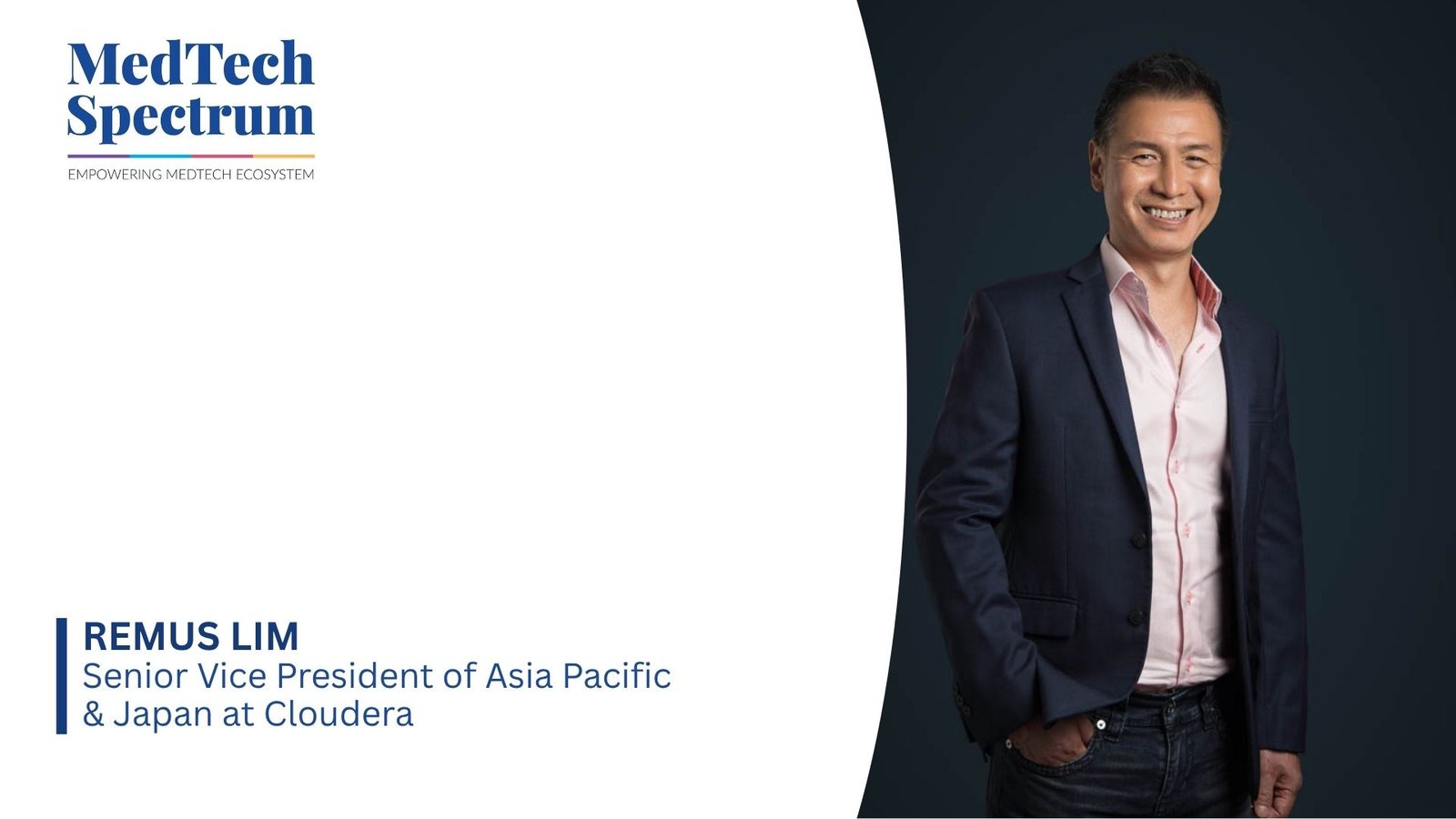
In this interview with MedTech Spectrum, Remus Lim, Senior Vice President, Asia Pacific & Japan (APJ), Cloudera, discusses the evolving AI landscape in healthcare, the importance of hybrid data architectures, strategies for balancing innovation with patient privacy and regulatory compliance, and the investments healthcare organisations should make today to unlock the full potential of AI-driven care across the Asia-Pacific region.
Singapore's National AI Partnership with Google highlights growing momentum for AI in healthcare. In your view, what are the biggest infrastructure and data challenges healthcare organisations must overcome before frontier AI can deliver meaningful clinical and research outcomes?
With healthcare data being highly fragmented, the biggest challenge lies in whether healthcare organisations have the data foundation to use these frontier models safely and meaningfully. Systems such as electronic health records, laboratories, imaging systems, claims, research databases and connected devices often operate on different standards, with different access controls and different levels of data quality. As a result, AI systems may only see a partial view of the patient, which limits both clinical usefulness and trust.
According to Cloudera’s Data Readiness Index 2026, healthcare organizations globally face significant data governance and infrastructure roadblocks, as 45 per cent of respondents do not have access to 100% of the data needed for AI initiatives. This applies specifically in Asia Pacific, where demand for healthcare is rising faster than many systems can respond. KPMG notes that 73 per cent of Asia Pacific healthcare leaders report that data silos significantly limit data utilisation, while 97 per cent of hospital-produced data remains unused.
Before frontier AI can deliver meaningful outcomes, healthcare organisations need interoperable data pipelines, real-time access to high-quality clinical context, consistent governance, and deployment environments that can support both experimentation and production. Without that foundation, AI remains trapped in pilots, unable to translate into clinical decisions, research acceleration or measurable patient impact.
Healthcare data is often fragmented across hospitals, laboratories, research centres, and cloud environments. Why is a hybrid and governed data architecture becoming essential for deploying AI at scale, and how does it differ from traditional centralised data strategies?
Healthcare data does not, and often should not, live in one place. Some of this data is too sensitive, too large or too regulated to move freely into a single central repository.
Traditional centralisation assumes that data must be moved into one lake or warehouse before it can be used. While that approach can work for some datasets, it becomes difficult in healthcare because of privacy rules, residency requirements, legacy systems and the need for real-time clinical context. A hybrid architecture takes a different approach: it allows organisations to bring analytics and AI to the data, rather than forcing all data to move.
The governance layer is what makes this scalable, as it ensures common policies for access control, privacy, lineage, auditability and data quality across distributed environments. This verifies that AI models are using consistent, trusted inputs and delivering reliable outcomes regardless of where the underlying data sits.
As AI-powered applications such as clinical copilots, biomedical research assistants, and agentic AI systems gain traction, what new data management, governance, and interoperability requirements should healthcare organisations prepare for?
Clinical copilots may summarise patient histories, surface care recommendations or draft documentation. Biomedical research assistants connect literature, trial data, molecular information and patient cohorts. Agentic AI systems may go a step further by querying systems, initiating tasks, routing cases or preparing next-best actions for human review. This shift raises the bar for data management: these tools need complete, contextual and trusted data. They also need metadata that explains where the data came from, how current it is, how it has been transformed and what usage restrictions apply.
Healthcare organisations using multiple systems for storage, analytics and AI need to maintain independence from vendor lock-in and interoperability without the need to copy sensitive patient data onto a proprietary island. Adopting open table formats like Iceberg, open engines and catalogues, open source compute engines and APIs with common governance policies allow teams to work on the same governed data without forcing unnecessary copies or moving all of the data to a single provider in order for it to deliver value.
For agents, the requirements are even more stringent because they can act across tools and workflows. Healthcare organisations need clear controls over data privacy, access permissions, monitoring and robustness. Agents should only access the data and systems required for their task, and every action should be logged for auditability. They must also be designed to handle conflicting inputs and unexpected errors safely.
Trust is fundamental in healthcare. How can technologies such as data lineage, auditability, governance, and explainability help clinicians, researchers, and regulators build confidence in AI-generated insights and clinical recommendations?
Trust in healthcare AI depends on whether users can understand how an insight was produced and whether it can be relied on in the context of the organisation. Clinicians cannot act on a black-box recommendation without knowing what data informed it and whether the output suits the patient in front of them. Researchers need reproducibility and regulators need evidence that the system is controlled, monitored and accountable.
Data lineage provides the first layer of confidence. It traces information from the source through every transformation, model input and output. This means being able to see how a lab result, prescription, imaging report or patient record moved through the AI data pipeline before influencing a recommendation.
The experience of the Hong Kong Hospital Authority illustrates why a trusted data foundation came first. Responsible for more than nine million patient records across 43 public hospitals and 30 data source systems, the organisation first focused on creating a unified data platform capable of bringing together disparate healthcare data at scale. The impact extended well beyond technology. Real-time visibility into patient flow helped reduce A&E access blocks from around 12 per cent to 3 per cent. That same foundation is now supporting AI-driven initiatives designed to assist diagnosis and treatment, helping clinicians access better information and identify potential abnormalities earlier.
With increasing regulatory scrutiny around patient data privacy and AI governance, how can healthcare providers strike the right balance between accelerating innovation and ensuring security, compliance, and patient trust?
Innovation accelerates when teams have approved environments, reusable controls and clear rules for how data can be used. The first priority for healthcare providers is visibility into where their data sits and who has access to it. This is supported by encryption, anonymisation or pseudonymisation, role-based access controls, audit trails and continuous monitoring.
The second priority is controlled AI development. Healthcare organisations should create governed environments where models and agents can be tested safely before deployment. Sensitive data should not be copied into uncontrolled tools or moved unnecessarily across environments. Instead, AI, analytics and governance should be brought to the data wherever it resides.
Risk-based oversight is also important. A tool that summarises administrative notes should not face the same controls as one that supports diagnosis, treatment or triage. Higher-risk use cases need stronger validation, explainability, human review and post-deployment monitoring. Strong governance should therefore be positioned not as a brake on innovation, but as the foundation that allows healthcare AI to scale safely.
Patient trust would depend on being able to show that sensitive data is protected, used only for approved purposes, and subject to human accountability where clinical risk is involved.
Looking ahead, what emerging AI trends do you believe will have the greatest impact on healthcare and life sciences across the Asia-Pacific region over the next three to five years, and what strategic investments should healthcare organisations make today to become AI-ready?
For healthcare organizations to harness AI efficiently, they must first eliminate the industry’s largest operational bottleneck, which is unstructured data locked inside document-heavy workflows. Healthcare organizations face financial pressures from manual document abstraction, such as covering claims, clinical documentation, and remittance advice, due to complex data structures and rigid protected health information (PHI) constraints.
This structural challenge directly contributes to a wider data accessibility crisis. To overcome this, organizations should consolidate their document-heavy processes into the same secure environment as structured PHI, decreasing operational expenditures while establishing the complete visibility required to successfully scale AI.
Unlocking these understructured document pipelines will be vital for the next frontier of care, which is multimodal AI. True clinical predictive intelligence relies on a unified, longitudinal patient record. By successfully structuring document data, organisations can seamlessly combine clinical records, medical imaging, genomics, and wearable data to detect complex risk patterns earlier. This capability supports a shift towards highly preventive care. IDC forecasts that by 2030, multimodal AI will predict 50 per cent of chronic and rare diseases before symptoms, making predictive care a reality, while 50 per cent of Asia Pacific providers will deploy advanced risk stratification tools by 2028.
Prescription intelligence serves as a practical example of this progression. Moving beyond optical character recognition (OCR), advanced AI workflows and agents can extract drug names, dosages, and instructions from unstructured text, validate them against trusted medical databases, and escalate ambiguous cases. This model shows where healthcare AI is heading: not full autonomy, but controlled, governed automation that improves operational speed while keeping humans in charge of high-risk decisions.
Additionally, agentic AI will continue to play a crucial role in clinical and operational settings, but its value will depend on sound governance. IDC expects 33 per cent of top-tier hospitals in Asia Pacific to deploy AI agents for real-time decision support and autonomous workflows by 2030. This reinforces the need for strong data quality, interoperability, explainability and human oversight. To become AI-ready, healthcare organisations should invest now in longitudinal patient records, interoperable data platforms, hybrid architectures, unified governance, auditability and workforce readiness. The organisations that lead will be those that align data, governance and clinical workflows before scaling AI.