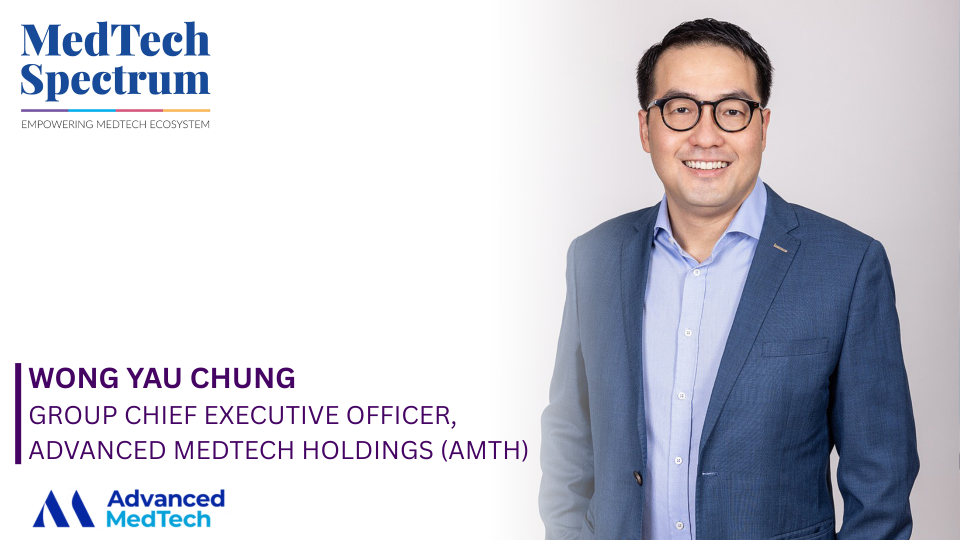
As Asia-Pacific’s MedTech sector navigates a period of economic uncertainty, tightening healthcare budgets, and rapid technological change, companies are being challenged to innovate responsibly while staying closely aligned with real-world clinical needs. From AI-driven patient engagement tools to scalable product portfolios designed for diverse healthcare systems, adaptability has become a defining factor for long-term success.
In this exclusive interview with MedTech Spectrum, Wong Yau Chung, Group Chief Executive Officer of Advanced MedTech Holdings (AMTH), explored how the company is positioning itself for 2026 and beyond. The conversation delves into the impact of macroeconomic pressures on APAC’s MedTech landscape, the role of artificial intelligence platforms such as UroGPT™ in enhancing patient experience without compromising clinical trust, and how AMTH balances premium surgical systems with cost-effective consumables.
The interview also highlights how AMTH’s integrated urology ecosystem, spanning subsidiaries like Dornier MedTech, provides resilience amid global volatility, and outlines the company’s strategic priorities around regulation, partnerships, and sustainable growth across both mature and emerging markets in the region.
Volatile tariffs, geopolitical uncertainty, and tightening government budgets marked 2025. How do you see these macroeconomic pressures shaping APAC’s MedTech landscape in 2026? Will it be a year of consolidation, cautious growth, or renewed expansion?
Across APAC, 2026 is shaping up to be a year of cautious and uneven growth for the MedTech sector. The macroeconomic pressures of 2025, from geopolitical uncertainty to tighter public spending, are now clearly filtering through healthcare systems across the region and is no longer confined to traditionally cost-sensitive markets. Even more developed healthcare systems such as Japan and China are operating under greater fiscal constraint, and hospitals are becoming more deliberate in their investment decisions.
However, healthcare investment does not stop; it becomes more selective and strategic. What we are seeing across APAC is a tendency to defer major decisions rather than terminate them outright. Hospitals are extending the use of existing assets, focusing on efficiency, and waiting for the right moment to re-enter the market. From experience in markets such as China and selected Southeast Asian countries like Vietnam, these periods of delay often result in pent-up demand returning in waves, rather than a gradual recovery.
In this environment, clinical value and system impact matter more than ever. Technologies that improve procedural efficiency, enable new surgical techniques, or help healthcare systems manage rising demand with limited resources continue to see interest. Innovation has not slowed but expectations around relevance and outcomes are much higher.
At the same time, APAC is not moving at a single speed. We continue to see pockets of growth, particularly in Malaysia, Vietnam, Indonesia, and India, where hospital expansion and capability upgrading remain active. These markets are still focused on catching up with modern clinical standards and medical innovation.
As such, 2026 will be a year defined by readiness, where MedTech companies that understand local dynamics, stay close to clinicians, and are prepared for demand cycles, will be best positioned to grow.
The surge in AI innovation has sparked both excitement and concern about a potential “bubble.” How is AMTH balancing aggressive innovation, especially with platforms like UROGPT, with the need for sustainable, long-term value creation?
At Advanced MedTech (AMTH), we are very conscious that AI in healthcare must be approached with responsibility and not hype. Innovation matters, but trust, safety, and long-term clinical value matter more.
If we take UROGPT as an example, one of the biggest concerns around patient-facing AI tools today is hallucination, which is the risk of generating inaccurate or misleading medical information. It arises when a generative model is asked to produce text, image or other content without strict constraints or clear guidance [1].
From the outset, we designed UROGPT very differently from a general-purpose chatbot. Its knowledge base is carefully designed, grounded in established clinical guidelines, and overseen by a medical advisory board that continuously reviews and updates its content. If the system does not have a validated answer, it does not speculate. This governance-first approach is critical to earning the confidence of both clinicians and patients.
More broadly, when it comes to AI-enabled clinical decision-making and automation, we believe this is an area that will evolve incrementally, not abruptly. Full autonomy in medical procedures remains a frontier space, and rightly so. The future is not about AI replacing clinicians, but about layering intelligence in a way that supports them.
One analogy that has resonated strongly with me in terms of understanding the boundaries of AI is “autonomous driving” in self-driving cars. We do not hand over full control immediately. Instead, the system is designed to introduce guardrails, guidance, and assistance, while the human driver remains firmly in charge. So, we see clinical AI developing in a similar manner, starting with decision support, workflow optimisation, and real-time guidance, before gradually expanding, as confidence, evidence, and regulation mature.
This philosophy shapes how we invest and innovate. We focus on practical, use-case-driven AI that improves education, efficiency, and consistency today, while laying the groundwork for more advanced capabilities in the future. By taking a step-by-step approach, anchored in clinical validation and human oversight, we believe we can avoid the risks of an AI bubble and instead build solutions that deliver sustainable value across the patient journey and care pathway.
Consumers globally are feeling financial strain, and healthcare systems are under pressure to deliver more with less. How is AMTH adapting its portfolio from premium systems such as Thulio to single-use consumables to support both cost-conscious healthcare providers and evolving patient expectations?
We recognise that healthcare systems across APAC operate under very different conditions. There are the advanced economies such as Japan, Singapore, Hong Kong, parts of China (such as Shanghai, Beijing) and Korea, which benefit from sophisticated healthcare systems that are organized, and have universal healthcare benefits and good healthcare innovation in place.
But there are also considerable variations across the healthcare systems of other Asian countries such as Indonesia, Philippines, Vietnam, Laos, Cambodia, India, and Malaysia where the budgets are often constrained yet demand is growing. Thailand and Malaysia stand out for strong universal coverage and reforms, India and Vietnam are expanding rapidly but face inequality and disparities in access between rural and urban communities, Indonesia and the Philippines are modernizing but costs, access, and governance remain issues, while Laos and Cambodia remain comparatively fragile, and are still heavily reliant on aid and private spending.
Our mission and also our passion at AMTH is to meet the needs of the people in different healthcare systems, which is why we have built a tiered and scalable portfolio designed to support a wide range of clinical settings.
On one end, we continue to invest in advanced flagship platforms, such as Dornier Thulio™, our pulsed Thulium:YAG laser with RealPulse® technology, that enable the latest surgical techniques and support high-acuity care in more specialised centres. Concurrently, we are expanding our range of single-use solutions and consumables, to ensure hospitals with more constrained infrastructure can still deliver safe and effective treatment.
From a patient perspective, expectations are consistent where patients want good outcomes and trust their physicians to make the right decisions. It is therefore critical that urologists are equipped with appropriate options, regardless of where they practise.
By offering solutions that are fit for purpose across different care environments, we are able to extend access to treatment, reach hospitals that were previously underserved, and ensure that patients do not miss out on care simply because of where they live or are treated. Ultimately, our approach allows us to support healthcare providers in delivering more with less, while continuing to advance innovation where it matters most.
AMTH spans the entire urology ecosystem through subsidiaries such as Dornier MedTech. How does this integrated model help the company navigate turbulent global conditions better than competitors with narrower portfolios?
In APAC, where healthcare systems operate under very different economic, regulatory, and infrastructure conditions, integration gives us a clear advantage. Through subsidiaries such as Dornier MedTech and WIKKON in China, AMTH spans a broad spectrum of urology solutions. This allows us to support hospitals and clinicians across multiple care settings, from highly specialised centres in mature markets to hospitals in emerging economies that are still building capabilities. In a volatile environment, this breadth means we are not dependent on a single product category or market segment and can adapt as demand shifts across the region.
Our integrated model also gives us portfolio and operating flexibility. When healthcare systems face pressure, we can respond by aligning the right solutions to the right setting, rather than forcing a one-size-fits-all approach. This has been particularly important across APAC, where budget constraints, procurement models, and clinical maturity vary significantly from country to country.
Just as importantly, integration allows us to stay close to clinicians. Because our range encompasses devices, consumables, and supporting services, we can engage more deeply with urologists and understand how care is delivered on the ground. That proximity helps us adjust faster, prioritise relevant innovation, and continue supporting treatment access even during periods of uncertainty.
As an extension of this integrated approach, we have also developed usage-based clinical service models in the United States, where pay-per-use structures are more established. While this model is currently US-specific, it reflects the same underlying philosophy: building flexibility into how care is delivered and ensuring treatment continuity even when traditional purchasing models are under pressure.
Our integrated ecosystem gives AMTH greater resilience, optionality, and relevance particularly in APAC, compared with competitors that operate with narrower portfolios or single-track business models.
With AI-powered, patient-facing tools on the rise, how do you envision technologies such as UroGPT shaping the patient journey and clinical decision-making across APAC in 2026?
I believe we will see patient-facing AI tools like UROGPT playing a very practical and impactful role in supporting the patient journey, rather than directly driving clinical decision-making. Presently, UROGPT is designed as a one-way support tool for patients, not a diagnostic or decision-making system for doctors. Information from UROGPT is not fed back into clinical systems or used to guide treatment decisions, and that distinction matters.
What it does extremely well is take pressure off clinicians by addressing the high volume of routine, repetitive questions that patients ask before procedures, after procedures, and during recovery. For example, patients often contact clinics with questions such as, “Is blood in the urine normal after surgery?”, “Do I need to fast?”, etc. While addressing these questions is important, they add to the clinician’s workload significantly. By handling these queries reliably and empathetically, UROGPT helps free up clinicians’ time while giving patients timely reassurance and guidance. The feedback we received from doctors has been very positive for this reason.
From the patient’s perspective, this meaningfully transforms their experience. Conversations with UROGPT are not transactional or rigid. In fact, patients often engage for several minutes at a time, as if speaking with a real person. The ability of modern AI to respond in a more empathetic and conversational manner helps patients feel supported throughout their treatment journey, rather than being overwhelmed.
When it comes to clinical decision-making, however, we see AI evolving along a separate, more cautious path. This is happening primarily through clinician-facing tools that support learning, reflection, and efficiency, not autonomous decision-making. One example we are seeing is the use of AI to capture and analyse procedural data after surgery, allowing clinicians to review the duration of each procedure, how techniques varied, and where improvements can be made. Over time, this kind of feedback reinforces learning and consistency, with the clinician remaining firmly in control.
As such, across APAC in 2026, we expect AI to shape healthcare in two complementary ways:
Patient-facing AI, like UROGPT, improves education, reassurance, and engagement while reducing administrative burden.
Clinician-facing AI, introduced step by step, supporting workflow optimisation and continuous learning rather than replacing medical judgment.
Taken together, this balanced approach allows AI to enhance both patient experience and care delivery while maintaining trust, safety, and clinical accountability.
Looking ahead, what strategic priorities will define AMTH’s growth plan for 2026 and beyond, especially in regions facing economic slowdown or regulatory tightening?
As we look toward 2026 and beyond, our growth strategy is anchored around two core priorities, which are regulatory readiness and partnership-driven execution.
First, on regulation, we see tightening standards across many APAC markets as a sign of system maturity. Over the past few years, countries such as Thailand, the Philippines, and China have continued to strengthen their regulatory frameworks, and we have prepared for this by consistently operating to high global regulatory standards. This approach allows us to adapt more smoothly as local requirements evolve.
Rather than slowing innovation, more structured regulatory environments can also create opportunities. For us, the priority is to invest early in regulatory capabilities and align innovation with national healthcare objectives.
The second strategic priority is partnership. In an environment shaped by economic pressure and policy evolution, MedTech companies need to be closely attuned to local conditions. This means listening carefully to clinicians, understanding priorities of healthcare systems, and engaging constructively with regulators and policymakers.
We believe growth increasingly comes from collaborative models by working alongside healthcare providers, distributors, and government stakeholders to support shared goals such as access, efficiency, and quality of care. We have seen how strong public–private partnerships can work effectively in markets such as Singapore, and we believe similar partnership-driven approaches will become even more important across APAC.
In essence, our strategy is not about reacting to uncertainty, but about building resilience and alignment. By combining regulatory excellence with strong local partnerships, we believe AMTH is well positioned to continue growing, innovating, and delivering impact even in markets navigating economic and policy transitions.
References: