The Union Budget 2026 has laid out a clear roadmap for strengthening India’s healthcare and life sciences ecosystem, with a sharp focus on innovation, advanced manufacturing, affordability, and capacity building. Industry leaders and healthcare professionals have broadly welcomed the measures, noting their long-term potential to position India as a global hub for healthcare, wellness, and biopharma manufacturing.
Reacting to the Budget, Prashant Girbane, Director General, Maratha Chamber of Commerce, Industries and Agriculture (MCCIA), said the Budget reflects stability and certainty, with no major economic shocks. “A stable budget that ensures growth, reduced fiscal deficit, lower debt-to-GDP ratio, and higher capital expenditure is always a welcome one,” he said.
Girbane highlighted the government’s achievement in bringing the fiscal deficit down to 4.4 per cent, below the 4.5 per cent target promised post-COVID. “To make a commitment five years ago and deliver on it deserves appreciation,” he added.
On the sectoral front, Girbane said the Budget’s emphasis on biopharma aligns well with the Economic Survey’s vision of strategic global interdependence. “Pharmaceuticals are one of India’s frontier technology industries. Strengthening biopharma not only drives Atmanirbharta but also makes India indispensable in global value chains,” he said.
He noted that the focus on biopharma will significantly benefit Maharashtra, particularly Pune and Mumbai, home to major players such as Serum Institute, Lupin, and Emcure. Girbane expressed hope that the Budget’s announcements will be executed effectively to deliver tangible outcomes over the coming year.
Commenting on the Budget’s implications for the nutraceuticals and wellness sector, Amit Srivastava, Founder and Chief Catalyst of Nutrify Today, said the government’s intent is evident even without headline tax announcements.
“The Union Budget signals a clear intent to position India as a serious global health and wellness manufacturing hub. While nutraceuticals didn’t receive headline tax relief, the deeper enablers—biopharma-led R&D, AYUSH institutional strengthening, trade facilitation, and manufacturing incentives create a structurally positive runway,” Srivastava said.
He added that for both Indian brands and international players, the message is clear: “India is open for innovation, collaboration, and long-term value creation in supplements and nutraceutical ingredients.”
Healthcare experts have also highlighted the Budget’s emphasis on accessibility and affordability, particularly for women’s health and cancer care. Dr Kanika Batra Modi, Assistant Director and Clinical Lead – Gynaecological Oncology at Max Institute of Cancer Care, Saket, noted that several proposals could significantly strengthen care delivery in non-metro regions.
“The Union Budget 2026 reflects a forward-looking approach towards strengthening India’s healthcare ecosystem, with a welcome focus on accessibility, affordability, and capacity building,” Dr Modi said.
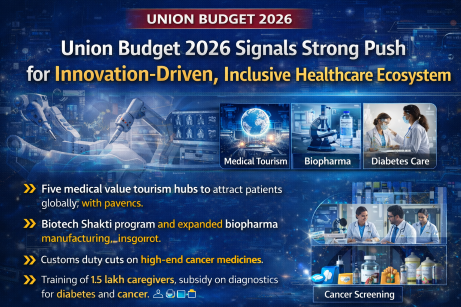
She highlighted the proposal to train 1.5 lakh multi-skilled caregivers as a major boost for maternal and women’s healthcare, especially in Tier II, Tier III, and rural areas.
The expansion of emergency and trauma care centres across district hospitals, she noted, is an important step toward safer pregnancy and reproductive healthcare services. “Duty exemptions and cost relief on 17 lifesaving drugs, including critical cancer treatments, will help improve affordability and patient access,” Dr Modi added, also welcoming investments in mental health infrastructure and allied healthcare training.
From a health-tech and innovation perspective, Surjeet Thakur, Founder and CEO of TrioTree Technologies, said the Budget sets a strong long-term direction for India’s healthcare ambitions.
“Union Budget 2026 backs innovation, advanced manufacturing, and global competitiveness in healthcare,” Thakur said. He pointed to the Biopharma Shakti initiative, with an outlay of Rs 10,000 crore over five years, support for biologics and biosimilars, and plans to build integrated medical hubs in partnership with the private sector as key enablers.
Thakur also welcomed the exemption of basic customs duty on 17 cancer drugs, calling it “a highly welcome step that will make critical therapies more affordable.”
However, he noted that a stronger increase in public healthcare spending could have further strengthened last-mile access, particularly in rural and underserved regions.
Overall, industry and clinical voices see the Budget as a positive move towards building an inclusive, innovation-driven healthcare ecosystem aligned with the vision of Viksit Bharat, balancing affordability with long-term competitiveness on the global stage.