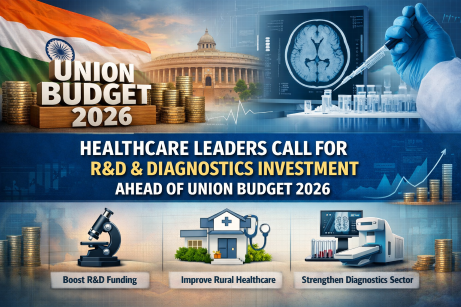
Healthcare leaders across India have urged for strengthening research & development in the healthcare sector in India, ahead of the Union Budget 2026.
The diagnostics market in India was worth $13 billion in the year 2023 and is estimated to grow twice its present size by 2028, as per Statista. Some of the factors contributing to this growth are the increasing number of chronic diseases, an ageing population, and the rise in the adoption of government insurance programs. Besides, technological advancement has played a major role when it comes to convenience and accessibility in the diagnostics market.
The diagnostics market in India consists of various segments, such as Pathology, the largest and valued at $8 billion, Radiology, worth more than $5 billion, and the In Vitro Diagnostics market, projected to reach $1.73 billion by 2025 with an annual growth rate of 5.22 per cent through 2030. The diagnostic imaging devices market is projected to reach $708.16 million by 2025. The growth is driven by increasing regular and preventive health checkups, the advancements in home-based diagnostic technologies, and the expansion of government insurance programs
Finance Minister Nirmala Sitharaman is going to present the Union Budget 2026-27 on February 1st, 2026. There is a call for an increase in public health expenditure. As per research, medical expenses have increased because of social and economic transitions and inequitable access to treatment. The study titled ‘Impact of Determinants of Healthcare Expenditure in India: The ARDL Bounds Testing Approach’ published in the International Journal of Advanced Research in December, analyses national data that spans more than three decades from 1991 to 2023, as per PTI, examining the factors driving healthcare expenditure, covering both out-of-pocket expenses and overall per-capita expenditure. According to the study, secondary education enrollment, per capita income, inflation, urbanisation, per capita health expenditure, and life expectancy have a long-term impact on both household out-of-pocket payments and overall healthcare expenditure. The study further suggests that education and life expectancy are correlated with lower per capita total health expenditure, and urbanisation is negatively correlated with per capita OOP expenditure. The study also points to a strong dependence on private, out-of-pocket expenses and a structural problem within the healthcare financing model in India. This results in people from rural areas and underserved regions being exposed to rising medical costs, financial hardships, and delays in treatment.
Dr. Somnath Chatterjee, Chairman & Joint Managing Director, Suraksha Diagnostic Limited shares: “GST from selective items should be reduced or removed to reduce the costs of important life-saving diagnostic tests. Input costs of tests necessary for chronic, noninfective diseases, which are the main health burden, should be reduced. There should be greater investment in building infrastructure for establishing medical device companies to lower the burden of imports. Establishment of diagnostic infrastructure should be incentivised at the block and village level.”
Union Budget 2025-26 has allocated Rs 95,957.87 crore to healthcare, below 2 per cent of GDP. Ahead of Union Budget 2026-27, healthcare sector leaders expect allocation of beyond 2 per cent towards the healthcare sector, combined with structural reforms focusing on preventive healthcare and capacity building. Harnessing healthcare service delivery in rural areas is one of the priorities, along with improving infrastructure in tier 2 and tier 3 cities.