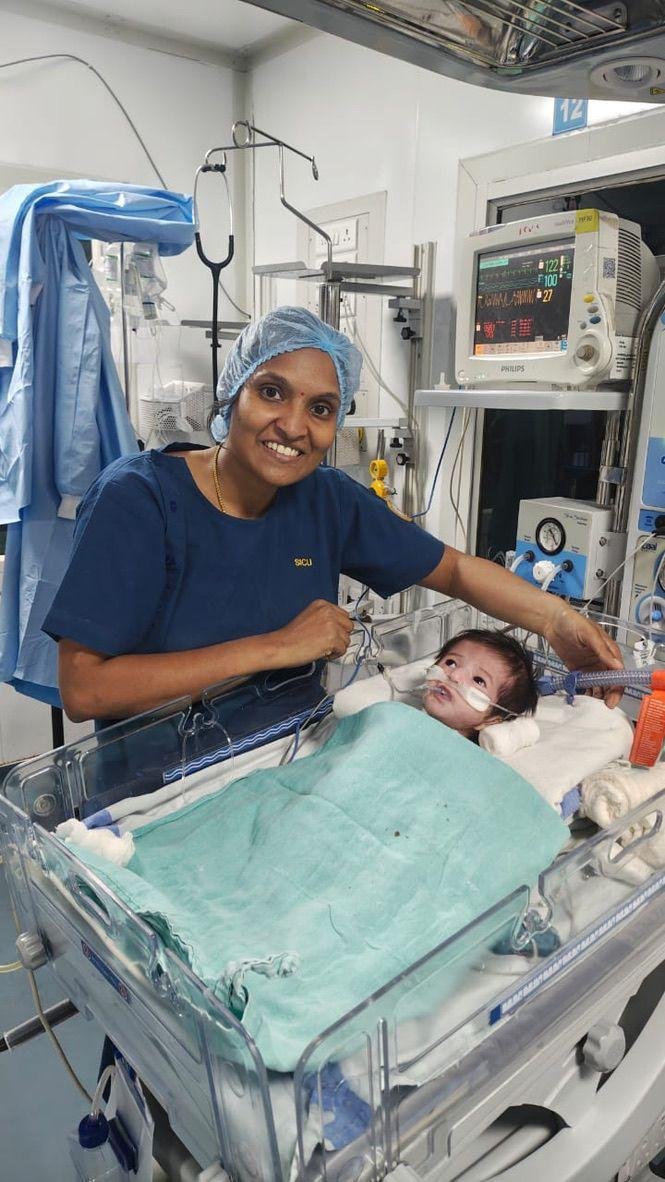
In a major milestone for military medicine, the Army Institute of Cardio-Thoracic Sciences (AICTS), Pune, has successfully performed its first neonatal Extra-Corporeal Membrane Oxygenation (ECMO), saving the life of a newborn with exceptionally rare and life-threatening congenital heart disease.
Baby Arpit, born at Command Hospital, Kolkata to a serving soldier after a precarious pregnancy marked by multiple miscarriages, became extremely sick within a few hours of birth, with his heart unable to pump enough blood to the body, due to an underlying severe heart disease. He was diagnosed with a complex combination of severe cardiac anomalies, rendering immediate survival impossible without advanced medical intervention. A timely lifesaving procedure at Command Hospital stabilised the infant.
The baby, although in stable condition, still required definitive treatment which involved an open-heart surgery for which he was shifted to AICTS, Pune.
AICTS is a pioneer institute of Armed Forces with a rich history of many firsts in the fields of Cardio-thoracic Surgery, Cardiology and Respiratory Medicine.
Arpit had reached just the right place to be cured of all his ailments. But the story didn’t have the expected happy ending so soon. Team AICTS was soon to be tested to the hilt. He underwent a stormy period which started with a lung infection and low kidney function that precluded his early surgery. The multidisciplinary team of specialists at AICTS, stabilised him using advanced neonatal intensive care, including high-frequency ventilatory support and peritoneal dialysis, eventually undergoing corrective surgery after initial stabilisation of his lung and kidney functions.
Due to his critical heart and poor lung condition, he could not be weaned off ventilator in the postoperative period and had to be taken up for surgery while on ventilatory support. Even after completion of the surgery his lungs and heart could not take the load of pumping blood just yet; he needed a “bridge” to tide over the crisis and give his own heart and lungs some time to recover. This bridge is what is called the “heart-lung support machine” or Extra-Corporeal Membrane Oxygenation (ECMO) machine in medical parlance.
ECMO is a critical lifesaving process, you can probably say the last weapon in our armamentarium to try and maintain the body’s oxygenation and circulation. The whole blood of a person is routed through this machine and it oxygenates and pumps the blood through the body. An artificial heart and lung.
Employing ECMO even as an adult is a challenge, as it needs a highly trained staff to institute and maintain this support, implementing ECMO in a neonate weighing less than three kilograms required exceptional precision, round-the-clock vigilance and seamless teamwork across specialties. But at AICTS, the team of paediatricians, nursing staff, cardiac-thoracic anaesthesiologists and paediatric cardiologists were able to achieve the pull off this feat.
After nearly ninety hours on ECMO support, Arpit came out of it stronger. Hisheart and lungs recovered, allowing successful weaning from life support and independent breathing. He showed he was a fighter by birth.
This achievement marks the first successful neonatal ECMO at AICTS, reaffirming the institute’s status as a national centre of excellence and reflecting the Indian Army’s enduring commitment to world-class care for its personnel and their families.