Obstructive sleep apnea (OSA) remains one of the most prevalent yet undertreated chronic conditions worldwide, with continuous positive airway pressure (CPAP) therapy, while clinically effective, facing persistent challenges around long-term patient adherence. As a result, a significant proportion of patients with moderate to severe OSA remain inadequately treated, creating an urgent need for alternative, patient-centric therapies that address the underlying mechanisms of airway collapse.
Against this backdrop, Nyxoah is advancing a differentiated approach to sleep apnea treatment through its Genio system, a bilateral, externally powered hypoglossal nerve stimulation therapy designed specifically for patients who are unable to tolerate CPAP. With no implanted battery and full-body MRI compatibility, Genio represents a new generation of neuromodulation technology aimed at reducing long-term procedural burden while expanding treatment flexibility for both patients and clinicians.
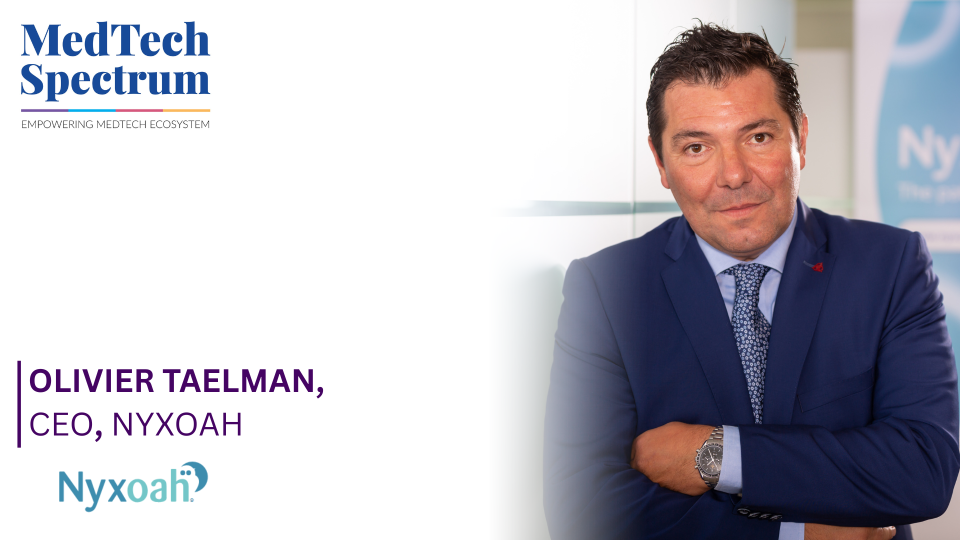
In this interview with Medtech Spectrum, Olivier Taelman, Chief Executive Officer of Nyxoah, discusses the unmet needs Genio seeks to address, the clinical and operational implications of its unique design, and the significance of Nyxoah’s expanding European footprint, including the recent launch in the Netherlands. He also shares his perspective on how neuromodulation is evolving within the future standard of care for obstructive sleep apnea.
What unmet needs in obstructive sleep apnea treatment does the Genio system address, particularly for patients who are unable to tolerate CPAP therapy?
Continuous positive airway pressure (CPAP) remains the first-line therapy for obstructive sleep apnea (OSA), but long-term adherence is a well-documented limitation. Large observational studies and systematic reviews report that approximately 30–50% of patients are non-adherent or discontinue CPAP over time, primarily due to discomfort, mask intolerance, noise, or lifestyle burden.
The Genio® system is designed specifically for moderate to severe OSA patients who are unable to tolerate or adhere to CPAP, addressing a recognised treatment gap. By using hypoglossal nerve stimulation (HGNS) to activate upper-airway dilator muscles during sleep, Genio targets the underlying pathophysiology of airway collapse rather than relying on pneumatic splinting. Clinical evidence from Nyxoah’s DREAM pivotal study has shown that bilateral HGNS with Genio can significantly reduce apnea-hypopnea index (AHI) and improve oxygenation and patient-reported outcomes in appropriately selected patients.
Genio is described as a bilateral, externally powered neuromodulation system without an implanted battery. How do these design features translate into long-term clinical and operational advantages for patients and healthcare providers?
Genio’s bilateral stimulation is intended to activate both branches of the hypoglossal nerve, supporting a more symmetrical tongue movement and airway opening. This approach is based on established physiological understanding of upper-airway muscle control and has been evaluated clinically in the DREAM study program.
The system is also externally powered, meaning there is no implanted battery. From a clinical and operational standpoint, this design eliminates the need for battery replacement surgeries, which are required with battery-dependent implantable systems and can add procedural risk (including increased infection rate) and increase long term costs. For healthcare providers, this can simplify long-term patient management and reduce lifetime procedural burden. For patients, it avoids repeat surgeries solely related to power depletion, while allowing future upgrades through the external components rather than additional implants.
The Netherlands marks an important milestone in Nyxoah’s European rollout. How does this launch fit into your broader commercial and market access strategy across Europe?
The commercial launch in the Netherlands represents a stepwise expansion strategy across Europe, focused on countries with established sleep-medicine infrastructure, experienced implanting centres, and clear reimbursement pathways. Nyxoah has previously emphasised a disciplined, country-by-country rollout, prioritising clinical excellence and sustainable adoption rather than rapid geographic expansion.
The Netherlands fits this strategy well, given its strong academic sleep centres and structured care pathways for OSA. The launch builds on Nyxoah’s existing CE-mark and prior European clinical experience and supports the company’s broader objective of establishing Genio as a differentiated HGNS option across selected European markets, while U.S. commercialisation progresses in parallel.
From a clinician adoption perspective, what feedback have you received from the first implanting centres in Amsterdam and Heerlen, and how is this shaping your engagement with additional hospitals?
Initial feedback from the first implanting centres in Amsterdam (OLVG) and Heerlen/Sittard (Zuyderland), as publicly communicated by Nyxoah, highlights clinician interest in Genio’s bilateral stimulation concept, absence of an implanted battery, and MRI compatibility. Physicians involved in the first implants have emphasised the value of expanding treatment options for CPAP-intolerant OSA patients.
This early experience is informing Nyxoah’s engagement with additional hospitals by reinforcing a peer-to-peer clinical education model, where experienced centres share practical insights on patient selection, implantation workflow, and follow-up. At this stage, feedback remains early and qualitative, and Nyxoah has not published comparative adoption metrics beyond these initial centres.
MRI compatibility remains a key concern for implantable medical devices. How significant is Genio’s full-body 1.5T and 3T MRI compatibility in driving physician and patient confidence?
MRI access is a well-recognised concern for patients requiring implantable devices, particularly given the lifetime likelihood of needing diagnostic imaging and especially in the OSA patient population who often suffer from comorbidities that could require MRI scans. Genio is full-body MRI-conditional at both 1.5T and 3T, as specified in its regulatory labeling and instructions for use. This level of MRI compatibility is clinically significant because it allows patients to undergo standard MRI examinations without device explantation or major restrictions. For physicians, it reduces long-term contraindication concerns during patient selection. For patients, it provides reassurance that future diagnostic needs (cardiac, neurological, musculoskeletal, or oncologic) can be addressed without compromising OSA therapy.
Looking ahead, how does Nyxoah see the role of neuromodulation evolving in the future standard of care for obstructive sleep apnea?
Neuromodulation is increasingly recognised as an important non-CPAP therapeutic option within the OSA treatment continuum. Professional society guidelines already acknowledge hypoglossal nerve stimulation as an established alternative for selected patients with moderate to severe OSA who cannot tolerate CPAP.
Looking forward, Nyxoah anticipates that neuromodulation will play a growing role as clinical evidence expands, patient phenotyping improves, and long-term outcome data mature. Rather than replacing CPAP, neuromodulation is expected to complement existing therapies, enabling a more personalised, mechanism-based approach to OSA management—particularly for patients who remain underserved by conventional treatments.