Each new device market used to mean a fresh dossier, a fresh queue and fresh questions about evidence another regulator had already accepted. That arithmetic has changed more in the past eighteen months than in the decade before.
Singapore and Malaysia moved their mutual reliance programme from pilot to implementation on 1 March 2026. Australia's Therapeutic Goods Administration refreshed its list of comparable overseas regulators in May 2026. India's Medical Devices (Third Amendment) Rules, 2026 added EU approvals to its clinical-investigation waiver in August. In September, the Saudi Food and Drug Authority published a dedicated reliance guidance for devices.
None of these routes is a free pass. Each one decides which of your existing approvals it trusts and what it still wants to see for itself. So the question for an exporter, whether shipping from Pune or Penang, is no longer whether reliance exists. It is which first approval buys the most second markets. This guide maps the routes card by card, then answers that question in a single table.
|
How this list was built. A route qualifies if it is written into a regulator's published guidance, rules or announcement, names the reference regulators or audit programme it relies on, and is in operation as of October 2026 rather than merely announced. We drew on regulator pages and guidance documents (HSA, MDA, SFDA, TGA, Anvisa's IMDRF briefings, India's gazette notification as reported) and specialist regulatory press. Our target was seven; eight routes qualified. Reliance routes in the Philippines, Thailand and Vietnam could not be verified against primary guidance for this edition and are left out. |
◆ ◆ ◆
|
Accepts: US FDA 510(k), De Novo or PMA; Health Canada licence; TGA registration; Japan Shonin or Ninsho; EU notified body certificates; and, since the reliance programme, Malaysia MDA registration | Classes: B, C and D | Saves: less data than full evaluation, immediate listing for eligible Class B, and up to 30% shorter turnaround on the Malaysia route |
How it works
If you hold an approval from at least one of HSA's reference agencies, you can drop from Full Evaluation to the Abridged route. Hold more and you climb the ladder. One reference approval plus three years of marketing and a clean safety record opens Expedited Class C (ECR-1). Two reference approvals open ECR-2 and Expedited Class D. Class B devices meeting either condition can be listed immediately on submission and payment. Since the Malaysia programme, a device fully assessed by MDA's conformity assessment body can also take Singapore's abridged path; you select the Malaysia option in the SHARE system and attach the MDA certificate.
The catch
The reference approval must cover the same labelled use you want in Singapore, and Class I or exempt Class II approvals abroad do not count. Expedited routes exclude non-bioactive joint replacement implants at Class C, and at Class D they exclude active implantables and devices touching the central circulatory or nervous system. Any prior rejection or withdrawal by HSA or a reference agency knocks you off the faster tracks.
Best paired with: two reference approvals, typically FDA plus an EU certificate
|
Accepts: Singapore Medical Device Register listing | Classes: B, C and D | Saves: about 30 working days of conformity assessment review instead of 60 |
How it works
If your device is on Singapore's register, Malaysia lets a conformity assessment body verify rather than redo the assessment. The pilot ran from 1 September 2025 to 28 February 2026, and MDA confirmed the route took effect on 1 March 2026 under its guidance MDA/GD/0070. HSA puts the review at about 30 working days against 60 under the full route, with registration following within a further 30 working days.
The catch
Classification must match in both systems; a device that is Class C in Singapore and Class D in Malaysia falls out. Class D devices carrying a registrable drug in an ancillary role are excluded, and you still need a Malaysian authorised representative and complete technical documentation for the verifier.
Best paired with: an HSA registration obtained through Route 1
That two-way traffic between Singapore and Malaysia is the cleanest example in Asia of reliance that runs in both directions. Hong Kong shows the other model: a long list of trusted approvals feeding a single listing system.
|
Accepts: approvals from the US, EU, Canada, Australia and Japan, plus China's NMPA and Korea's MFDS (from 1 January 2024) and Singapore's HSA (announced 28 March 2024) | Classes: medical devices Class II to IV; IVDs Class B to D | Saves: an expedited track for products with two or more recognised approvals |
How it works
Hong Kong's Medical Device Administrative Control System lists devices on the strength of approvals elsewhere. If you have two or more recognised approvals, an existing Local Responsible Person, and no deaths, serious injuries, active recalls or field safety actions anywhere, you qualify for expedited handling. Submissions run on the Medical Device Information System, which opened for listing applications on 15 April 2024.
The catch
Class I devices and Class A IVDs cannot be listed at all. The practical pull is procurement: since October 2023 the Medical Device Division has prioritised MDACS-listed devices in public hospital purchasing, so listing is commercially necessary even where it is administrative in form.
Best paired with: HSA plus one Western approval, which also serves Singapore and Malaysia
|
Accepts: EU notified body and UK approved body certificates, FDA 510(k), De Novo and PMA, Health Canada licences, Japanese approvals and QMS certificates, HSA register entries, MDSAP certificates and audit reports | Classes: all classes, with evidence scaled by risk | Saves: desk assessment instead of on-site audit at TGA's discretion; reduced audit level or fees on request |
How it works
The TGA's guidance (version 2.1, May 2026) lets you use overseas evidence two ways: to abridge a TGA conformity assessment, or to support inclusion on the ARTG directly. For Class IIa and IIb you pair a QMS certificate (MDSAP, EU, UK or TGA) with product evidence such as a 510(k) summary or Health Canada licence. Class III and higher-risk devices need stronger product evidence, such as a PMA or an EU design examination report. MDSAP and EU or UK audit reports can stand in for TGA surveillance assessments where scope is adequate and no safety signals exist.
The catch
The device must match the overseas one in design, intended purpose, users and indications, and the certificates must be issued to the manufacturer. Some applications are subject to mandatory audit under Regulation 5.3, and incomplete files are refused at preliminary assessment.
Best paired with: an MDSAP certificate plus FDA or EU product evidence
Australia trusts both product decisions and audits. Korea, by contrast, has opened only one door, but it is an expensive one to keep shut.
|
Accepts: MDSAP audit results | Classes: manufacturers of Class 2, 3 and 4 devices | Saves: an on-site K-GMP audit, replaced by a desktop review |
How it works
Since MFDS Notice No. 2023-79 took effect on 19 December 2023, you can submit MDSAP audit results for initial, additional and change K-GMP audits, which MFDS then handles as a desktop audit. For a foreign manufacturer, that removes the cost and scheduling of a Korean inspection team visiting the site.
The catch
This is quality-system reliance only; your product dossier is still reviewed in Korea. Renewal audits remain on-site, and a K-GMP certificate issued on MDSAP results expires with the MDSAP certificate. Manufacturers with significant MDSAP deficiencies, human-derived components or safety concerns are excluded.
Best paired with: a current MDSAP certificate with at least two years of validity left
|
Accepts: registration certificates from the MDSAP member authorities: Australia, Canada, Japan and the US | Classes: products needing a registration certificate; Anvisa's published briefings give no class breakdown | Saves: review time; separately, MDSAP-based GMP certificates now last four years instead of two |
How it works
Since June 2024, Instruction 290/2024 has let Anvisa rely on registration decisions from equivalent foreign authorities. Uptake is real: Anvisa told the IMDRF that as of February 2026 it had received 485 reliance requests, concluded 275 and approved 258, with reliance making up 14.1% of total requests. On the quality side, RDC 850/2024 doubled the validity of GMP certificates issued on MDSAP reports.
The catch
The EU is not on the list, so a CE-marked product without US, Canadian, Japanese or Australian approval gains nothing here. Anvisa has said it plans to add authorities but has not done so in the material we reviewed.
Best paired with: FDA clearance plus MDSAP certification, which serves both registration and GMP
Brazil shows reliance working at volume; Saudi Arabia has now written its own version down.
|
Accepts: approvals from the TGA, Health Canada, EEA national competent authorities, Japan's PMDA, the UK MHRA and the US FDA; MDSAP certificates and audit reports as QMS evidence | Classes: A, B, C and D | Saves: review cut to 35 working days against a standard 35 to 60 |
How it works
SFDA's guidance, version 1.0 dated 9 September 2026, lets you claim reliance if you hold a valid approval from at least one recognised regulator for a technically identical device. You file a reliance form and rationale, and MDSAP evidence can cover the quality system.
The catch
Self-registration, predicate-based equivalence and custom-made devices are excluded, as are products with significant post-market safety actions. Software and AI-enabled devices are at SFDA's discretion, and Saudi labelling, language and storage requirements still apply. The document does not state an effective date, so confirm handling with SFDA before planning around it.
Best paired with: FDA approval plus MDSAP
|
Accepts: approvals from the UK, US, Australia, Canada, Japan and, since August 2026, EU countries | Classes: new devices without a predicate | Saves: the requirement to submit local clinical investigation results |
How it works
Rule 63 of the Medical Devices Rules, 2017 lets the Central Licensing Authority waive clinical investigation data for a device without a predicate if it has been approved and marketed for at least two years in a listed jurisdiction. The Third Amendment Rules (G.S.R. 744(E)), notified on 14 August 2026 and published on 19 August, added EU countries to that list.
The catch
The authority must be satisfied with safety, performance and vigilance data, there must be no reason to expect different performance in Indian patients, and you must undertake a post-marketing clinical investigation. The amendment does not define which EU approval counts, so expect questions on whether an MDR certificate suffices.
Best paired with: two years of marketing under FDA or EU approval
◆ ◆ ◆
|
Reference approval |
Markets it helps unlock |
|
US FDA (510(k), De Novo, PMA) |
Singapore, Hong Kong, Australia, Brazil, Saudi Arabia, India |
|
Health Canada licence |
Singapore, Hong Kong, Australia, Brazil, Saudi Arabia, India |
|
Japan approval |
Singapore, Hong Kong, Australia, Brazil, Saudi Arabia, India |
|
TGA (Australia) |
Singapore, Hong Kong, Brazil, Saudi Arabia, India |
|
EU certificate or approval |
Singapore, Hong Kong, Australia, India; Saudi Arabia via EEA authorities |
|
MDSAP certificate |
Australia, Korea, Brazil, Saudi Arabia (quality system only) |
|
Singapore HSA |
Malaysia, Hong Kong, Australia |
|
UK approval |
Australia, Saudi Arabia, India |
|
Malaysia MDA |
Singapore |
|
China NMPA or Korea MFDS |
Hong Kong |
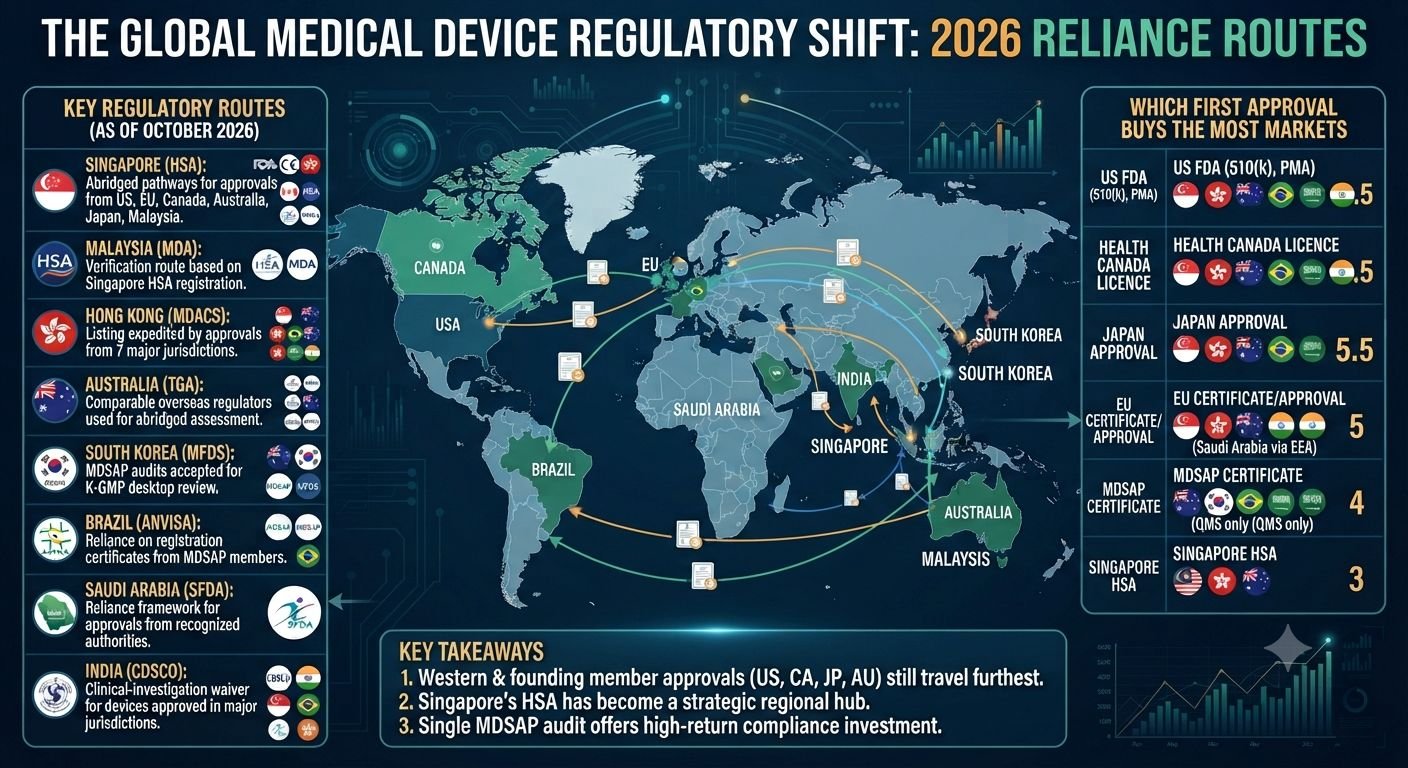
Read the table from the top and a pattern emerges. The approvals that travel furthest are still the ones issued by the founding members of the old harmonisation club: the US, Canada, Japan and Australia. A US clearance, backed by an MDSAP certificate, touches every route on this list except Malaysia, where the door runs through Singapore.
That is the second lesson. HSA has turned itself into a regional hub. Its register now counts in Malaysia, Hong Kong and Australia, and its own abridged ladder rewards companies that arrive with two Western approvals. For an Asian manufacturer without FDA clearance, a Singapore registration is the most efficient regional key available today.
The third lesson is about quality systems. Korea, Brazil, Australia and Saudi Arabia all accept MDSAP evidence in some form, which makes a single MDSAP audit one of the highest-return compliance investments a mid-sized exporter can make.
Finally, Indian manufacturers should note that CDSCO approval does not yet appear as a reference on any route here. Earning that status, starting with ASEAN neighbours, is a policy goal worth pressing for.
Organisations named in this list are welcome to respond; corrections of fact will be published.
© 2026 MM Activ Sci-Tech Communications. MedTech Spectrum. All rights reserved. This article is for information only and does not constitute medical, legal or investment advice.