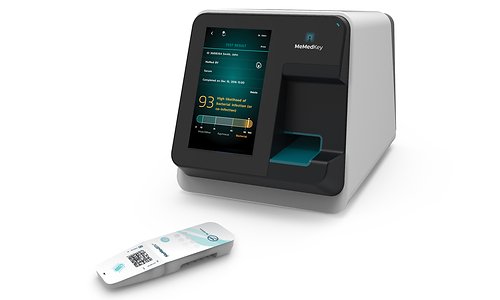
Tampa General Hospital (TGH) is advancing its longstanding commitment to improving sepsis care as the first academic health system in the Southeast to adopt MeMed BV, an innovative diagnostic test that reads the body's immune response to help clinicians rapidly distinguish between bacterial and viral infections.
The FDA-cleared technology provides results in approximately 15 minutes, giving emergency care teams additional information at a critical point in the clinical decision-making process. At Tampa General, the test has been integrated directly into the health system's existing electronic health record (EHR)-based ED sepsis alert workflow, helping clinicians determine which patients may require antibiotics and hospitalization and which may not.
The adoption follows extensive research led by Tampa General and USF Health physicians. In a study of both adult and pediatric emergency department patients, Tampa General conducted the largest sepsis study to date using host immune-response technology, demonstrating how the technology can be incorporated into a real-world sepsis workflow to support clinical decision-making.
"Sepsis requires us to move quickly, but speed alone isn't enough. Our teams also need the most precise information possible to make the right decision for each patient," said Michele Moran, MBA, MSN, RN, senior vice president of the Emergency Services Institute at Tampa General Hospital. "We have made a sustained commitment to improving how we identify and respond to sepsis, and by bringing emerging, evidence-based technology directly into the workflow our clinicians already use, we can give them more information sooner and continue to advance the quality of care we provide."
The study evaluated 893 adult emergency department patients between September 2024 and October 2025. Researchers assessed how adding MeMed BV to the existing sepsis alert workflow could help clinicians more accurately distinguish patients likely to have bacterial infection from those unlikely to have sepsis.
The findings demonstrated measurable clinical and operational impact. With MeMed BV, 26 per cent more patients were reclassified as unlikely to have sepsis, while cefepime (a powerful antibiotic) exposure decreased by 33 per cent and hospitalizations decreased by 13 per cent in patients with a Sepsis Alert. A preliminary cost-benefit analysis also estimated approximately $179,000 in savings per 100 patients through decreased admissions and decreased length of stay.