Every keen runner knows the moment. A dull ache appears in the knee halfway through the week. The watch says recovery is good, the training plan says tempo run, and the running app offers a beautiful chart of last month's mileage. None of them answers the only question that matters: should I run today, or will this turn into an injury?
That gap was the starting point for a presentation by MENINBLOX at a foreign press briefing during the 2026 Gangwon AI Healthcare Global Forum in Chuncheon on 28 October. Its title was deliberately provocative for a start-up audience: When Regulation Builds Trust. The company's argument is that in health AI, the fastest route to users is not to avoid scrutiny but to invite it.
More data than ever, still getting hurt
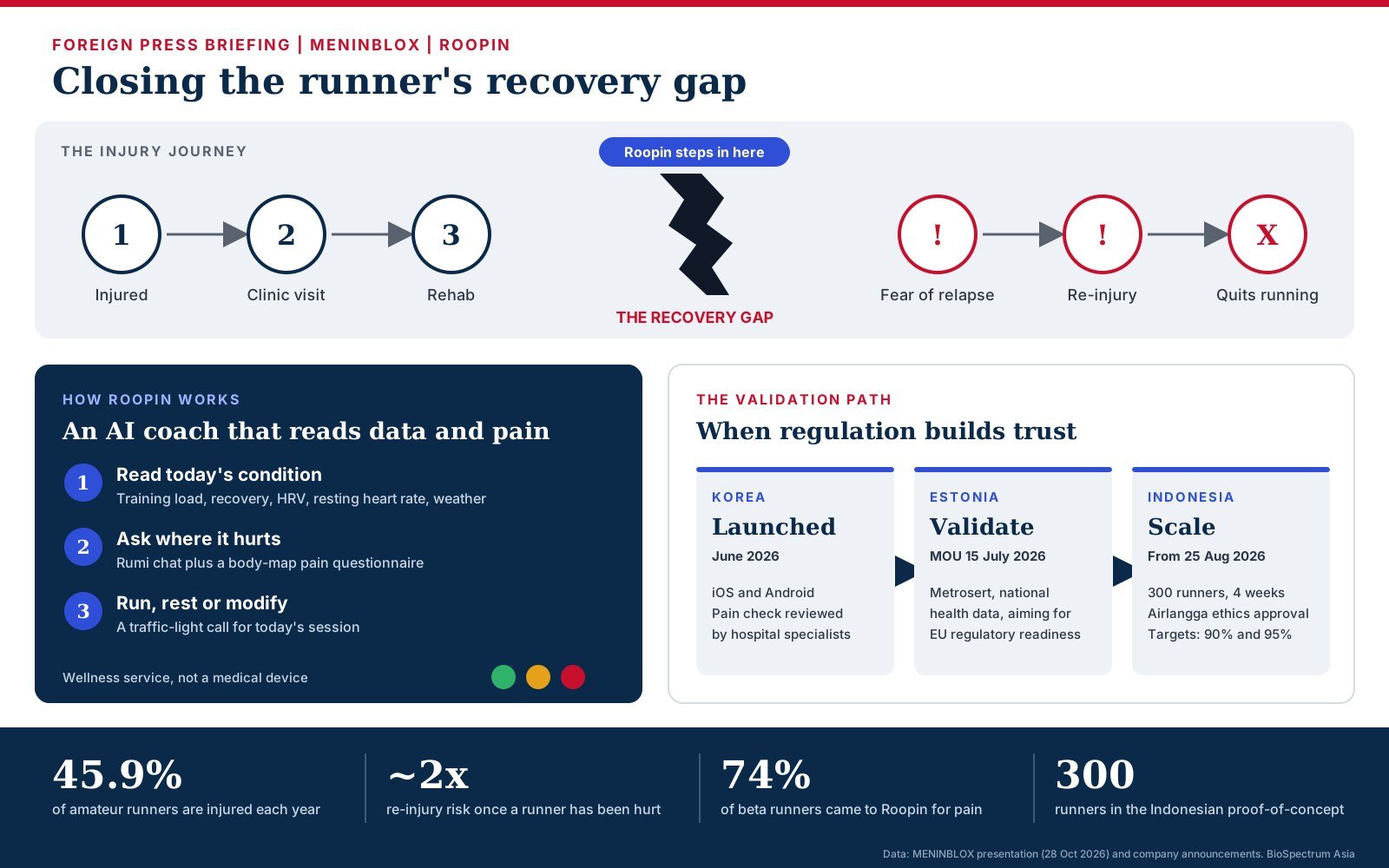
Runners have never been better measured. Watches track heart rate variability, resting heart rate, cadence and training load, and apps turn it all into graphs. Yet injury rates have barely moved. Research cited by MENINBLOX suggests that 45.9 per cent of amateur runners are injured each year, and that once a runner has been hurt, the risk of injuring themselves again roughly doubles.
The company describes what happens next as the recovery gap. A runner gets injured, visits a clinic and goes through rehabilitation. Then they are discharged back into the world with no one to help them judge their own pain. Fear of relapse sets in, many push too hard or too soon, re-injury follows, and a large share simply give up running altogether.
Wearables tell runners what their body did yesterday. Very few help them decide what to do with the pain they feel today.
An AI coach that reads your data and your pain
Roopin is MENINBLOX's answer. First shown at MWC 2026 in Barcelona and launched in Korea in June 2026 on iOS and Android, it pulls running and health data from Apple Health and Google Health Connect, including training load, recovery, heart rate variability and resting heart rate, and adds the day's weather. It combines these into a daily readiness view.
What makes it different is the second step. Through a conversational coach called Rumi, the app asks runners where it hurts. Users mark the painful area on a body map, front or back, and answer a short musculoskeletal questionnaire that the company says was reviewed by Korean university hospital specialists. Rumi then combines the pain signal with the data and recommends one of three things: run, rest, or modify the session, for example by swapping a run for strength training. The advice is presented as a simple traffic-light signal.
Early users seem to want exactly that. According to MENINBLOX, 74 per cent of its beta runners said they came to Roopin for one reason: pain. One beta tester, who runs around 200 kilometres a month, summed up the appeal in a line the company now puts on its slides: above all, the app worried about their injury.
MENINBLOX presents Roopin at the foreign press briefing, 2026 Gangwon AI Healthcare Global Forum, Chuncheon, 28 October 2026. Photo: BioSpectrum Asia
Product
Roopin, an AI running companion with a conversational coach called Rumi
Developer
MENINBLOX, Inc. (Korea). CEO Park Jong-hyung
Launched
Korea, June 2026, on iOS and Android; first shown at MWC 2026 in Barcelona
Data used
Training load, recovery, heart rate variability, resting heart rate and weather, via Apple Health and Google Health Connect
Pain check
Body-map musculoskeletal questionnaire, reviewed by Korean university hospital specialists
Status
Wellness service, not a medical device. Validation under way in Estonia and Indonesia
Why a wellness app is courting regulators
Here is the paradox at the heart of the story. Roopin is, by its own definition, a wellness service and not a medical device. Its website says plainly that its guidance does not replace a doctor's diagnosis or treatment, and it tells users with persistent pain, swelling or warmth to see a professional. Legally, it does not need clinical validation to sell in Korea.
Yet the moment an app starts advising someone whether to run on a painful knee, it is operating close to the line between fitness and medicine. Users will treat its advice as health advice, whatever the disclaimer says. MENINBLOX's bet is that evidence, earned through independent validation, will become its competitive advantage in a crowded field of AI running coaches, many of them backed by large consumer brands. In other words, regulation is not the obstacle to trust. It is how trust gets built.
Estonia: borrowing a nation's health data
The first step was Europe. On 15 July 2026, MENINBLOX signed an agreement in Tallinn with Metrosert, Estonia's state-owned national measurement agency and applied research centre. Metrosert's medical data unit uses Estonia's national health data to help health technology companies validate their products and prepare for the European market.
Under the agreement, the two will validate Roopin's AI questionnaire and coaching algorithms against real-world runner experience, including pain, physical condition and decisions about when to train and when to rest. Joint research and data cooperation are planned in stages, with the explicit goal of meeting EU regulatory requirements. CEO Park Jong-hyung called it the first joint validation by a Korean company with Metrosert and described Estonia as the gateway to European digital health.
The choice of Estonia is telling. It is one of the most digitised health systems in the world, with national electronic health records that make it an attractive test bed for companies that need credible, population-level data. For a small Korean start-up, an Estonian validation offers something no marketing budget can buy: a European stamp of seriousness.
Indonesia: proving it at scale
If Estonia is about credibility, Indonesia is about scale. On 25 August 2026, MENINBLOX began a four-week proof-of-concept with 300 runners recruited across Indonesia, working with SIRKA Science, a Southeast Asian chronic disease management company with which it signed a joint R&D contract in 2024 and had already piloted its AI questionnaire.
The study received ethics approval from the public health research ethics committee at Universitas Airlangga, one of Indonesia's leading universities. It is funded under the Korean government's 2026 overseas demonstration programme for AI and digital transformation companies, run by the Ministry of Science and ICT and NIPA.
Unusually for a consumer app, the company has published its targets up front: at least 90 per cent accuracy in judging whether a workout is safe, at least 95 per cent accuracy in detecting injury risk, and at least 35 per cent of AI recommendations accepted by runners. The pilot also tests de-identified collection and integration of health and exercise data in Indonesia. MENINBLOX has said it is aiming for commercial launch in the Indonesian market from October.
ROOPIN AT A GLANCE
45.9%
Amateur runners injured each year, per research cited by MENINBLOX
~2x
Re-injury risk once a runner has been hurt
74%
Beta runners who said they came to Roopin for one thing: pain
300
Runners in the four-week Indonesian proof-of-concept, from 25 August 2026
90% / 95%
Target accuracy for workout feasibility and injury risk detection in Indonesia
Sources: MENINBLOX presentation, 28 October 2026, and company announcements.
The Gangwon connection
MENINBLOX is one of the start-ups supported through the incubation programme of Gangwon's AI Healthcare Global Innovation Regulation-Free Special Zone, with backing from the Korea SMEs and Startups Agency and Gangwon Technopark. That fits the forum's broader message. Gangwon is not only trying to grow AI healthcare companies but to send them abroad with evidence in hand, whether that is GeoMex Soft's fall-prevention cameras in Estonia and Japan or AIDOT's cervical screening in Mongolia and Indonesia.
The questions still to answer
Where is the line? If Roopin's validation succeeds, regulators may start to ask whether advice on pain and injury risk is really wellness at all. A product proven to detect injury risk could find itself treated as a medical device in some markets, with all the obligations that brings.
Who is responsible? When an app tells a runner it is safe to run and they get hurt, liability is unclear. Clear disclaimers help, but trust built on validation also raises expectations.
Data across borders. Health data moving between Korea, the EU and Indonesia must satisfy GDPR in Europe and Indonesia's personal data protection law. De-identification is a start; governance will matter more as the user base grows.
Will runners listen? A 35 per cent acceptance target is honest, and revealing. The hardest part of injury prevention is often not the algorithm but persuading a determined runner to rest.
The business model. Consumer health apps live or die on retention and willingness to pay. Validation builds credibility, but MENINBLOX will still need a model that scales across very different markets.
Trust as a product feature
Most consumer AI start-ups treat regulation as something to delay. MENINBLOX is treating it as a feature to sell. By validating Roopin against national health data in Estonia and under ethics oversight in Indonesia, it is trying to earn the one thing every health app claims and few can prove: that its advice can be trusted.
Whether that strategy pays off will depend on the numbers from Indonesia and the progress in Tallinn. But the idea behind it deserves attention well beyond running. As AI moves from counting steps to telling people what to do with their bodies, the companies that win may be the ones that went looking for scrutiny before anyone forced them to.
Note: Beta user, injury and validation figures are as presented by MENINBLOX at the foreign press briefing on 28 October 2026 and in company announcements, and have not been independently audited. Roopin is marketed as a wellness service, not a medical device. Information current as of 28 October 2026