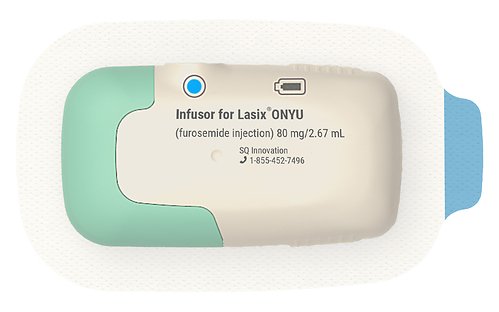
SQ Innovation announced that results of the SUBCUT HF II trial of its product Lasix ONYU have been published in the Journal of the American College of Cardiology (JACC), one of the leading peer-reviewed journals in cardiovascular medicine. The study reported that patients were able to treat themselves at home with a diuretic regimen administered subcutaneously, similar to what they may receive intravenously in a hospital. The study met its primary endpoint of reducing inpatient days. The topline result of the trial had been presented in the Hottest Trials session at Heart Failure 2026, the annual congress of the Heart Failure Association (HFA) of the European Society of Cardiology (ESC), held in Barcelona, Spain, in May 2026.
SUBCUT HF II is a multicenter, open-label, randomized controlled investigator-sponsored clinical trial that compared at-home treatment with Lasix ONYU to conventional inpatient treatment with IV diuretics. The trial enrolled 172 patients, aged 34 to 92, who were hospitalized with heart failure and required IV diuretic treatment, across 20 National Health Service (NHS) hospitals in the U.K. Patients were randomized 1:1 to either self-treatment at home using subcutaneous furosemide delivered via a wearable abdominal pump (Lasix ONYU), or continued inpatient treatment using IV furosemide.
"The conclusion that a diuretic treatment at home can replace conventional IV treatment in a hospital rests on two pillars: demonstrating that it can induce equivalent diuresis and that patients can safely self-administer a hospital-equivalent dose at home," said Pieter Muntendam, MD, Founder, President and CEO of SQ Innovation. "Previous studies conclusively reported the former, and this study provides evidence for the latter. Patients self-administered approximately 900 mg of furosemide over the course of treatment — comparable to what a patient may receive during a hospital admission — with similar treatment outcomes."
"Heart failure affects close to one in four Americans over their lifetime and is one of the leading causes of hospital admissions in the U.S. and around the world," said G. Michael Felker, MD, MHS, FACC, FAHA, FHFSA, Professor of Medicine, Division of Cardiology at Duke University School of Medicine. "As we have succeeded in doing for countless other medical conditions, we need to develop the tools and learn how to treat these patients in the comfort of their homes, reducing the burden on the healthcare system. This study illustrates how patients can self-administer a course of diuretic treatment comparable to what they may receive in a hospital."