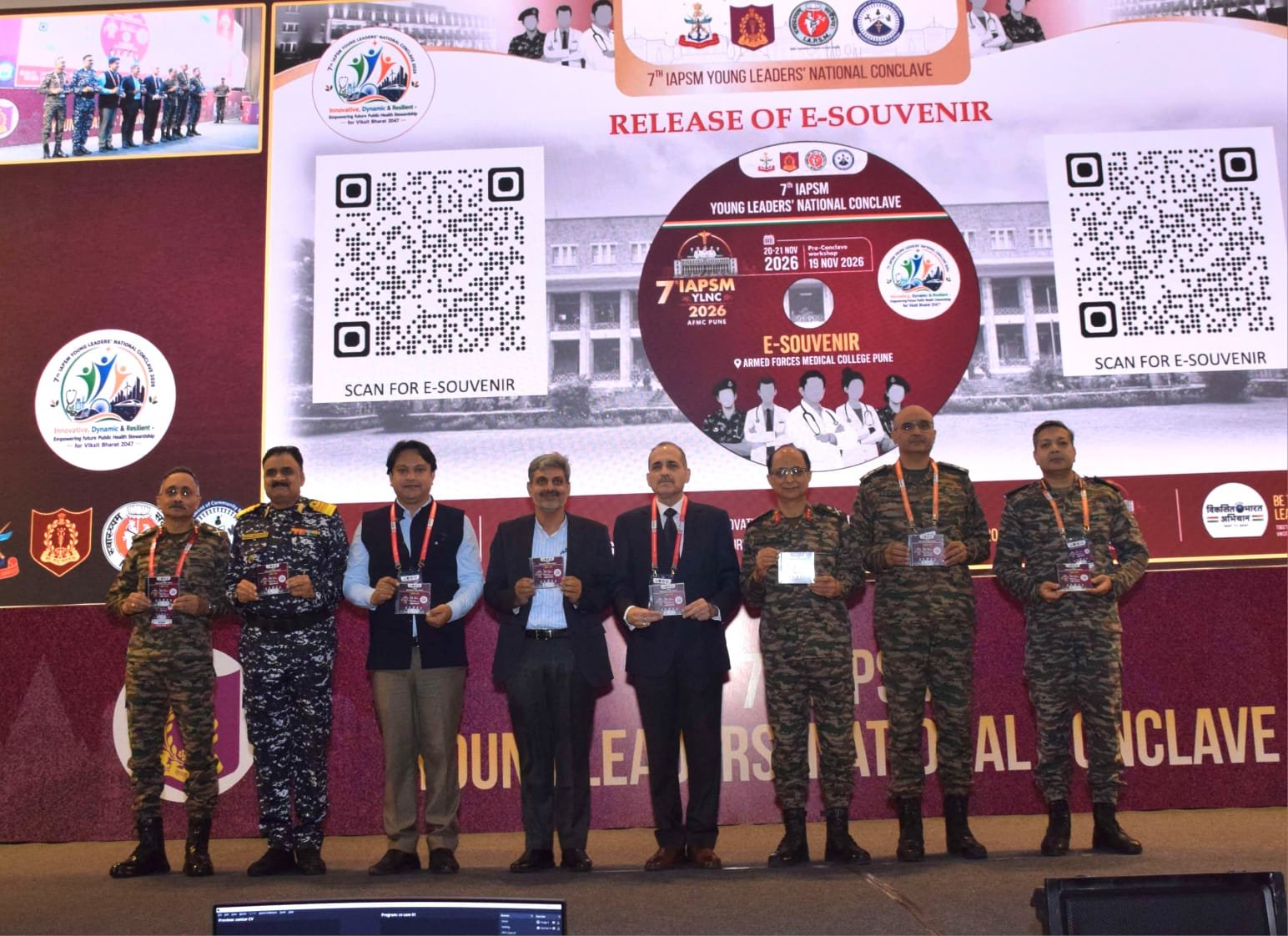
The Armed Forces Medical College (AFMC), Pune, hosted the three-day 7th IAPSM Young Leaders’ National Conclave (YLNC 2026) from 19–21 November 2026, bringing together public health experts, academicians, researchers, epidemiologists, postgraduate students and medical professionals to discuss emerging healthcare challenges and innovations in preventive and social medicine.
Organised by the Department of Community Medicine, AFMC, under the aegis of the Indian Association of Preventive and Social Medicine (IAPSM), the conclave was held under the theme ‘Innovative, Dynamic & Resilient – Empowering Future Public Health Stewardship for Viksit Bharat 2047’.
Dr Nipun Vinayak, IAS, Principal Secretary, Public Health Department, Government of Maharashtra, inaugurated the conclave and delivered the keynote address. He highlighted the importance of innovation, evidence-based practices and collaborative approaches in shaping the future of public health. Surg Vice Adm Manish Honwad, VSM, Director and Commandant, AFMC, attended the inaugural ceremony as the Guest of Honour.
Workshops highlight emerging public health technologies
The pre-conclave programme on 19 November featured hands-on workshops covering contemporary research methodologies and emerging technologies in public health. Key topics included questionnaire development and validation, geographic information systems (GIS) for public health, dengue bionomics, surveillance and control, health technology assessment, grant writing and budgeting, ethical use of artificial intelligence (AI), prediction modelling, systematic reviews and meta-analysis.
These workshops provided participants with practical exposure to research tools, analytical techniques and technology-enabled approaches to public health challenges.
Scientific sessions address AI, disease surveillance and healthcare priorities
The national conclave, held on 20 and 21 November, featured scientific plenary sessions, expert lectures and panel discussions addressing key areas of public health. Deliberations covered the applications of AI and big data in public health, disease surveillance and outbreak response, neglected tropical diseases, HPV vaccination, future-ready health systems, antimicrobial resistance, One Health, travel health and preventive healthcare for rural women.
The discussions also explored mentorship, career development pathways and the role of innovation in strengthening India's public health infrastructure.
Young professionals showcase research and innovation
Six competitions formed an important part of the conclave: Young Leaders’ Parliament, Public Health Hackathon, Quiz, Visual Storytelling, Content Creation and Lens on Photography. These initiatives provided young professionals with opportunities to demonstrate leadership, scientific knowledge, problem-solving capabilities and creative communication skills.
The Young Leaders’ Parliament encouraged discussions on public health policy and legislation, while the Public Health Hackathon focused on developing innovative solutions to real-world public health challenges.
The event also featured scientific paper and poster presentations by young faculty members, researchers and postgraduate students. Participants presented their research findings and engaged with academicians and public health experts. Winners across the competitions and scientific presentations received cash prizes and certificates.
The conclave concluded on 21 November with a valedictory session and closing remarks by Brig VS Grewal, Professor and Head, Department of Community Medicine, AFMC, and Chairperson of the Organising Committee, YLNC 2026.
The event reaffirmed AFMC and IAPSM's commitment to nurturing the next generation of public health leaders and advancing preventive and social medicine in India, in alignment with the country's long-term vision of Viksit Bharat 2047.