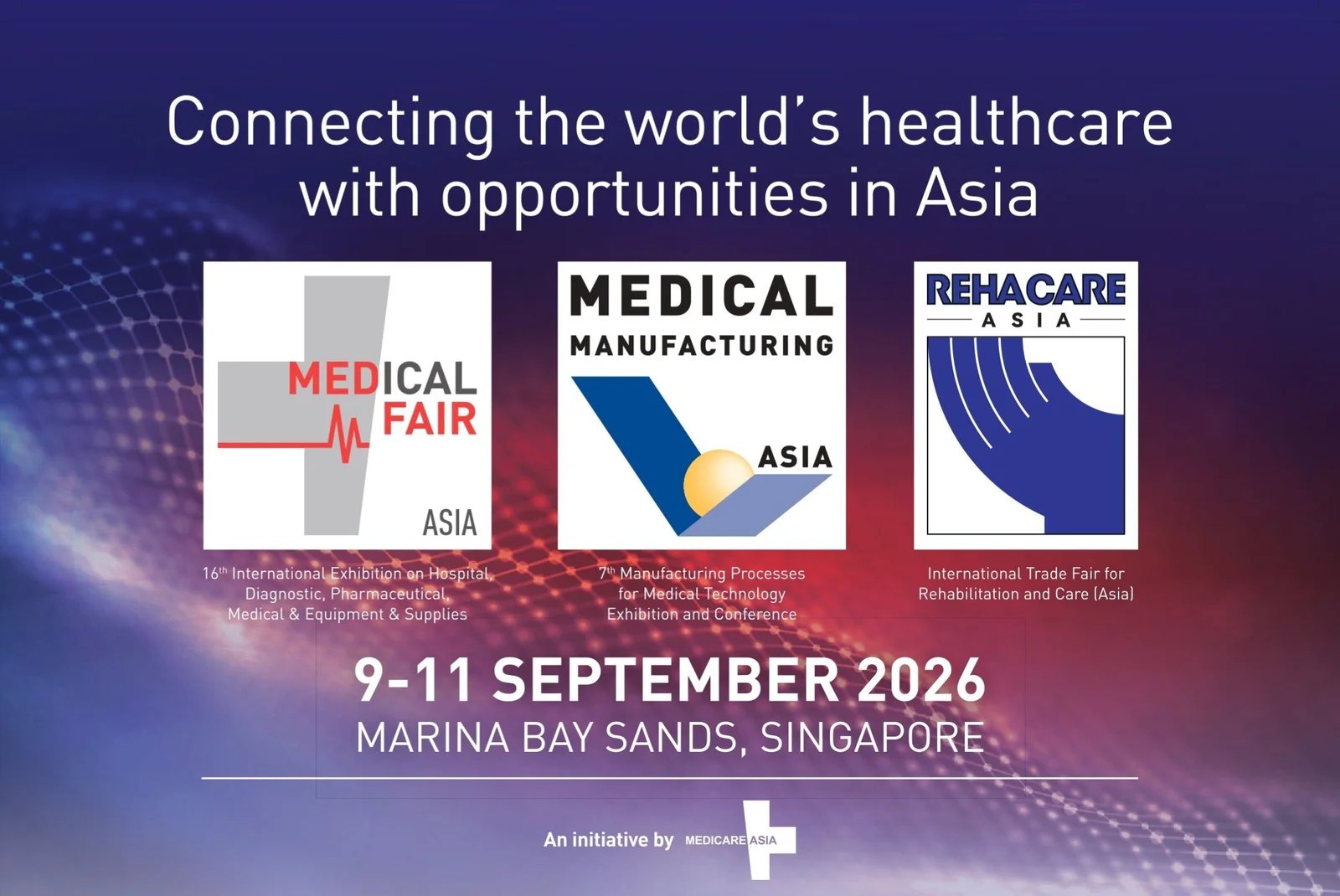
Healthcare leaders across Southeast Asia are confident about the future, but turning promising technologies into routine care remains a persistent challenge, according to new findings and discussions at the opening of Medical Fair Asia, Medical Manufacturing Asia and the inaugural RehaCare Asia on 9 September.
The ASEAN Care Readiness Index 2026 found that 94% of healthcare and MedTech leaders believe their organisations are prepared for the next three to five years. Yet 54% identified technology implementation capability as a barrier to future readiness, reflecting concerns raised during opening-day discussions around workforce capacity, fragmented pilots, affordability and adoption.
The three events opened at Marina Bay Sands, bringing together professionals across healthcare, MedTech, rehabilitation and medical manufacturing.
Low Yen Ling, Senior Minister of State for Trade and Industry and Culture, Community and Youth, officiated as Guest of Honour before touring the exhibition floor.
“The confidence and willingness across Southeast Asia to embrace new ideas and technologies in healthcare is very encouraging,” said Lars Wismer, Managing Director of Messe Düsseldorf Asia.
“The opportunity now is to bring healthcare providers, researchers, technology companies and industry together to turn promising solutions into everyday practice, strengthen care beyond the hospital and ultimately deliver better outcomes for patients.”
Four themes emerged from the first day of discussions.
Healthcare leaders highlighted that capacity is about more than headcount. Professionals need sufficient time, space and support to learn, adapt and integrate new technologies, alongside engineering, digital and operational expertise.
Participants also warned that the region risks accumulating “pilot debt”, where repeated small-scale feasibility studies delay the harder work of integrating proven technologies into routine care.
Cost, technical support, maintenance and scalability therefore need to be considered from the outset rather than after a pilot has been completed.
Another key theme was that adoption starts with people rather than products.
Technology can reach a hospital without becoming part of care if clinicians lack confidence using it or if stakeholders disagree on the value the technology is expected to deliver.
Care also needs to extend beyond institutional settings.
Rehabilitation outcomes, for example, depend not only on the technology used in clinics but also on patient motivation, caregiver and community support, access to suitable technology and meaningful data to sustain progress at home.
At the launch of the ASEAN Care Readiness Index 2026, Lars Wismer joined Dr May-Anne Cheong of Singapore General Hospital and National Cancer Centre Singapore and Dr Kamonlawan Chonchokun of KPMG to examine barriers preventing regional enthusiasm for innovation from translating into implementation at scale.
Dr Kamonlawan cited an example from a hospital in Ho Chi Minh City where a medical device was used fewer than five times a year because doctors lacked confidence in using it and could continue relying on older technology.
Low utilisation can then weaken the case for further investment.
The discussion also highlighted how competing definitions of value can stall adoption.
Clinicians may prioritise patient outcomes, governments may focus on funding sustainability and broader health objectives, while technology companies may emphasise adoption and access.
These priorities need to be aligned before technology investments can progress effectively.
AI-informed patients are also changing clinical conversations.
Patients are increasingly using tools such as ChatGPT, Gemini and Claude to understand their health before or between consultations.
The panel welcomed greater patient ownership while stressing the need for clinical and regulatory safeguards and support to help patients interpret AI-generated information in context.
Innovation showcased at Medical Fair Asia also reflected a broader move beyond institutional care settings.
The Innovation Zone featured Singapore-developed technologies including SUTD’s NeatSens sensor-integrated knee brace for remote rehabilitation assessment, its AMI voice-chatbot and cognitive-games platform for older adults, and lightweight wearable exoskeletons from the NUS Biorobotics Lab.
Launch Pad and FTR4H also featured Nunaps’ Vividbrain, an at-home virtual-reality digital therapeutic for stroke survivors with visual field defects.
At RehaCare Asia, discussions focused on what is required for rehabilitation technology to deliver value in clinics, homes and communities.
Speakers at the MotusAcademy × RehaCare Asia Leadership Forum argued that development should begin with patients’ real-world goals, with evidence demonstrating whether people regain meaningful function and sustain recovery outside the clinic.
Adjunct Associate Professor Loh Yong Joo also highlighted the physical demands placed on therapists and the potential for robotics to reduce workload, support workforce retention and enable greater rehabilitation intensity.
Affordability, servicing and maintenance remain barriers to wider adoption, prompting discussion of rental and technology-as-a-service models.
St Luke’s Hospital and Robotimize also signed a memorandum of understanding to test, refine and integrate rehabilitation robotics into real-world care.
Medical Manufacturing Asia meanwhile focused on the technologies and capabilities supporting medical-device development and production.
Solutions on display included precision engineering, components, advanced materials, micro- and nanotechnology, sensors, testing and quality control, and packaging.
The German Pavilion was among the international showcases, bringing together German medical technology and manufacturing companies and highlighting specialist capabilities supporting the wider healthcare technology ecosystem.
The conversation continues across 10 and 11 September.
Future for Health will examine AIoT, digital twins, wearable biofeedback and AI-driven health monitoring, while the Innovation Zone will continue showcasing emerging technologies from Singapore universities.
The Living Longer, Living Better seminar will focus on prevention, ageing in place, community care and rehabilitation access.
The Medical Manufacturing Asia Forum will examine AI-driven manufacturing, resilient supply chains, partnerships and regulation.
On 11 September, Paradigm Shifts in Healthcare will spotlight real-world applications of AI, robotics and healthcare innovation, including AI-supported pre-surgery assessment, autonomous hospital logistics and 3D-printed solutions.
Taken together, the opening-day discussions point to a shift in ASEAN healthcare innovation from demonstrating what technology can do towards proving how it can be integrated into routine care.
The region’s next challenge is not simply to generate more pilots, but to build the workforce, financing models, technical support and clinical confidence needed to make proven technologies part of everyday healthcare delivery.