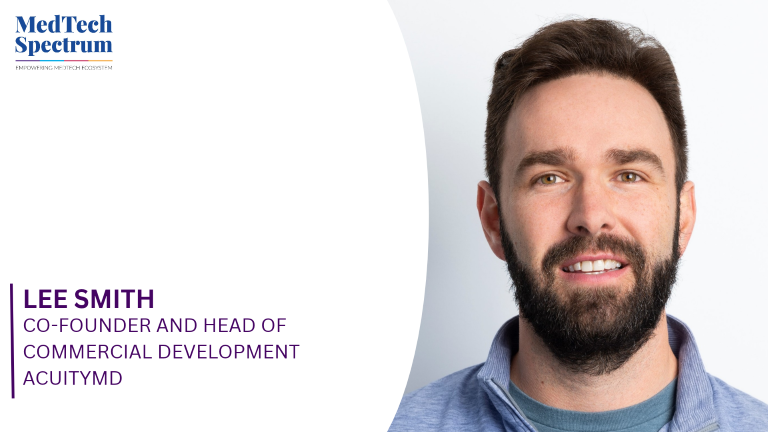
MedTech companies rely on accurate market intelligence to assess opportunities, understand patient pathways, evaluate competitors and make strategic investment decisions. However, traditional market research can take weeks or months, delaying critical business decisions. AcuityMD is addressing this challenge with a new AI-powered research agent integrated into its AcuityAI platform, designed to generate cited market analyses in minutes by connecting medical claims, reimbursement, clinical evidence, hospital purchasing and patient journey data. In this interview with MedTech Spectrum, Lee Smith, Co-founder and Head of Commercial Development at AcuityMD, discusses the technology behind the research agent, the role of the company’s proprietary MedTech ontology in improving analytical relevance, and how AI-driven market intelligence can support total addressable market assessment, indication expansion, competitive strategy and investment due diligence. He also explains the importance of transparent methodologies, verifiable evidence and human oversight in AI-assisted decision-making across the MedTech industry.
AcuityMD’s new research agent aims to reduce MedTech market analysis from weeks or months to minutes. What are the key technical capabilities behind this acceleration, and how does the agent’s proprietary MedTech ontology improve the relevance and accuracy of its findings compared with general-purpose AI tools?
AcuityMD’s new agent accelerates two critical parts of market analysis: 1) assembling the evidence and 2) analyzing it. Our platform currently incorporates connected claims, reimbursement, hospital purchasing, and clinical information and the agent builds on that foundation to plan research, query relevant sources, calculate results, and produce cited analyses around a defined market.
What makes our technology unique is AcuityMD’s proprietary MedTech ontology that can describe relationships between physicians, facilities, networks, procedures, and reimbursement. Those connections give the agent industry context perpetually missing from general-purpose LLMs. For example, a question asking about the details of a new device market requires an answer that goes beyond basic references to the device; rather, the analysis should identify relevant procedures, products, clinical indications, and economic relationships. This type of domain-rich analysis is significantly more relevant and in-depth compared to a surface-level response someone would get by posing their device market question to ChatGPT.
The platform provides company-, brand-, and product-level market share, pricing comparisons, and patient pathway analyses. What data sources underpin these capabilities, and how does AcuityMD address data quality, completeness, timeliness, and potential biases when generating market intelligence?
Our agent draws largely on de-identified U.S. medical claims, encounter volumes, reimbursement information, hospital purchase data, patient journey data, FDA product information, clinical literature and trial records (i.e., PubMed, ClinicalTrials.gov) as well as other sources.
Across all use cases, AcuityMD uses multiple data sources to create a more complete and reliable view of the market. The platform deduplicates claims and accounts for gaps in observed activity to provide this more complete picture. Our latest national market model draws on population demographics, insurance enrollment, and Medicare benchmarks. Cross-checking those estimates reduces dependence on any single source.
How does the research agent calculate total addressable market (TAM) for a medical technology product or a new clinical indication? What assumptions and variables are incorporated into these assessments, and how can users validate the results before using them for strategic planning?
AcuityMD’s agent uses multiple data sources across varying levels of detail to develop a defensible TAM, just as a professional analyst would. It can build a bottom-up model using procedure volumes, the number of devices used per procedure, and the average selling price per device. It can also extrapolate from hospital purchase data, which captures a subset of actual hospital purchase orders, and then incorporate external market reports and companies’ public filings.
Comparing those approaches helps users see where the estimates converge, understand why they differ, and identify which assumptions are driving the result. The goal is a market estimate supported by several lines of evidence, with assumptions users can inspect and validate.
The agent connects information on physicians, healthcare facilities, networks, procedures, and reimbursement. How does this integrated view help MedTech companies understand patient pathways, identify underserved market segments, and evaluate opportunities to expand product adoption?
Our research agent uses tokenized patient journey data to help MedTech companies visualize common pathways at scale, from diagnosis through treatment and follow-on care. Connecting those pathways with procedure volumes, clinical evidence, and reimbursement helps teams understand both how patients receive care and where a technology could improve that experience.
The agent can combine these sources to identify and investigate underserved segments. For example, clinical literature may describe patients who respond poorly to the standard of care. The agent can then use patient pathway data to help quantify that population and visualize how those patients move through treatment. Teams gain a clearer picture of the potential unmet need and the evidence needed to validate the opportunity.
The same approach supports indication expansion. The agent can draw on clinical literature to identify other indications where a therapy may have potential, then combine procedure volumes and patient pathways to assess the addressable populations. The agent can combine those analyses with evidence on regulatory requirements to produce a prioritized indication-expansion plan for the company’s clinical, regulatory, and commercial teams to evaluate.
AcuityMD highlights applications in competitive strategy, product management, investment due diligence, and mergers and acquisitions. Could you share examples of how the platform supports these use cases, and what measurable improvements customers can expect in decision-making efficiency or research outcomes?
Teams using AcuityMD’s research capabilities can test business hypotheses before committing capital. When it comes to competitive strategy, a team can look at market share versus a competitor as well as purchasing trends within a defined competitive set.
Teams can also use the agent for product management. For instance, they can research procedure trends, evaluate indications, and do a deep-dive into procedure economics.
There are several exciting use cases for the research agent around merger and acquisition strategy and investment diligence where teams can use the agent to investigate market sizes, the competitive dynamics of a market, and the clinical evidence behind an acquisition thesis.
Customers gain massive efficiencies. Research that traditionally took weeks or months can now be done in minutes. And this is research that is helping teams make mission-critical strategic decisions about their business, but now it’s taking considerably less time to compile and review.
The new research agent is currently available to select users. What are AcuityMD’s plans for broader deployment and further development of AcuityAI? How will the company ensure transparency, traceability, and appropriate human oversight as AI-generated market intelligence becomes more influential in high-stakes MedTech business decisions?
We are excited to deliver fast, multifaceted research capabilities into AcuityAI with ongoing evolution as the agent gets smarter.
Of course, AcuityMD’s research agent is designed to be used with a human in the loop. Users review the context, codes, and assumptions, then challenge the findings and revise the analysis. Citations and visible methodology help users inspect the evidence.
Ultimately, the agent’s role is to accelerate research but not make the investment or product decision. Leaders remain responsible for checking the evidence, testing material assumptions, and applying clinical, commercial, and financial judgment.