Fourteen months after the US Commerce Department opened its Section 232 investigation into personal protective equipment, medical consumables and medical equipment, there is still no proclamation. As of October 2026, the Bureau of Industry and Security lists the probe as open, with no report published and no duty imposed. The 270-day statutory clock for the Commerce report ran out around mid-2026, and Covington had flagged mid-September 2026 as the latest likely date for any announcement. That date came and went.
Then, on 5 October 2026, President Trump announced on Truth Social that Becton Dickinson would invest USD 3 billion in US manufacturing, and credited medical device tariffs he said would be in place by the end of the year. BD, for its part, says the deal buys it relief from future Section 232 tariffs on covered products. So one large importer has already bought certainty that everyone else lacks.
The precedent is not abstract. The parallel pharmaceutical probe produced tariffs that began on 31 July 2026. This scorecard deals only with devices, consumables and PPE, and asks one question: where would a tariff bite hardest?
|
How this list was built. A category qualifies if it is named in the Federal Register notice of 26 September 2025 (90 FR 46383) and has measurable US import dependence with a documented source-country split. The target was eight. HTS-level import values from USITC DataWeb could not be retrieved for this edition, so only four categories have enough verified concentration and duty data to score honestly. We rank by supplier concentration and the duty stack already in place. Sources: the notice, BIS, trade counsel briefings, trade press, company statements and attributed analyst estimates, to 23 October 2026. |
Any device tariff lands on a duty structure that has been rebuilt twice this year. On 20 February 2026 the Supreme Court ruled in Learning Resources, Inc. v. Trump that IEEPA does not authorise tariffs. A temporary 10% Section 122 surcharge filled the gap and expired on 24 July 2026. It was replaced the same day by a new Section 301 forced-labour duty across 60 economies: 10% for India, Malaysia and Mexico; 12.5% for China, Thailand, Vietnam and Singapore; and total-duty floors of 10% for the EU and 12.5% for Japan.
Two other layers matter. Section 301 China duties never went away, and USTR confirmed on 7 October 2026 that the 2018 to 2019 lists continue. The metals Section 232 regime was overhauled on 6 April 2026, with a 50% base rate on steel, aluminium and copper, 25% to 50% on certain derivatives and 15% through 2027 on certain metal-intensive equipment. One detail decides how the new layer interacts: goods covered by specified Section 232 measures are excluded from the forced-labour duty. A devices proclamation could therefore replace one layer rather than simply stack on top of it. Whether it would join that exclusion list is not yet known.
Two dates hang over all of this: China Section 301 exclusions covering about 20 Chapter 90 products run to 9 November 2026, and the US-China tariff reduction expires on 10 November 2026 unless renewed.
◆ ◆ ◆
|
Exposure at a glance: US imports: HTS-level value not verified for this edition | Top sources: country split not verified at HTS level | Duties already in place: EU 10% floor, Japan 12.5% floor, China Section 301 plus 12.5%, metals derivatives where listed |
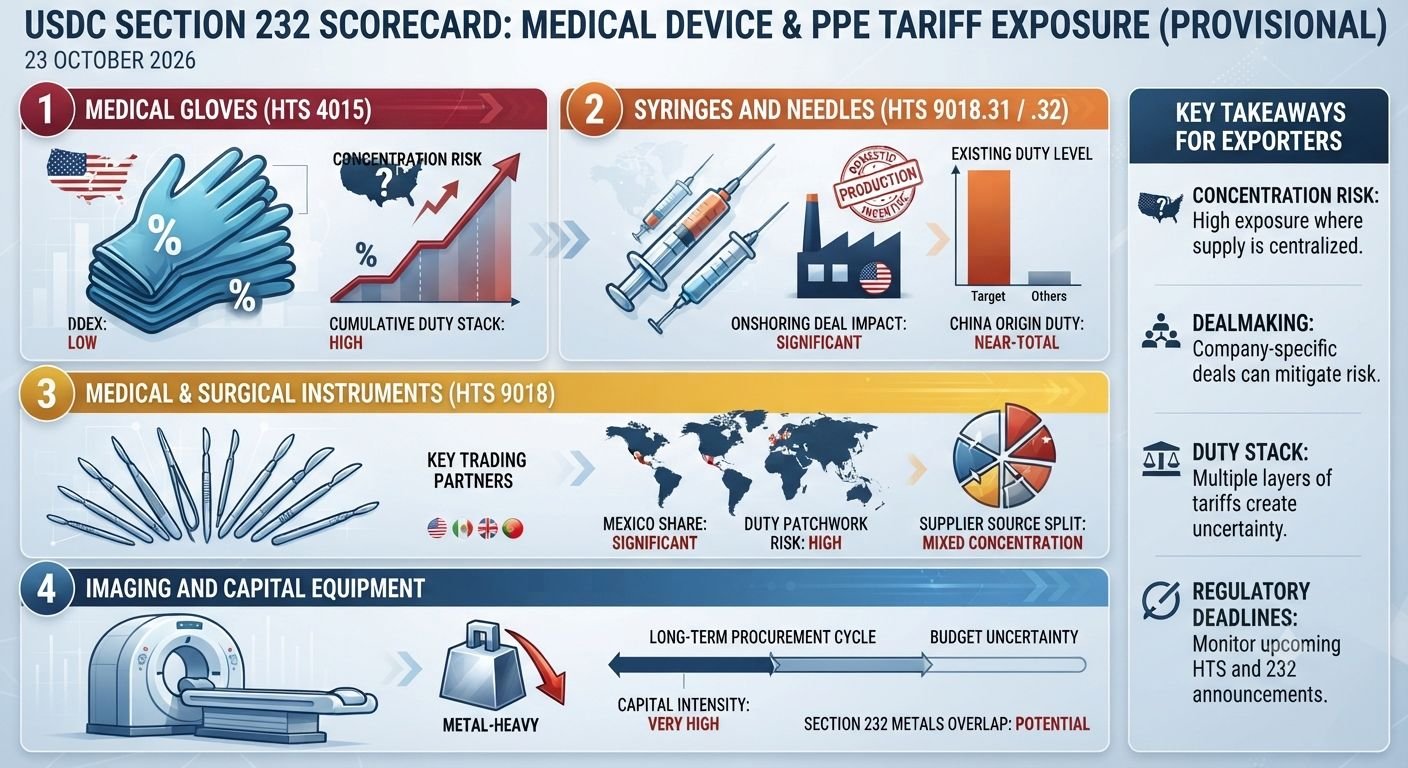
CT and MRI machines, X-ray and radiation equipment and electrosurgical apparatus are all named in the Federal Register notice. They start the countdown because they are expensive and hard to substitute. But no verified country split was available, so the concentration score stays provisional and the category ranks lowest.
What makes this category tricky is the metal. Magnets, gantries, shielding and housings are metal-heavy, and since 6 April 2026 the metals regime has applied to derivative articles at 25% to 50%, with a 15% rate through 2027 for certain metal-intensive equipment. The overhaul also eliminated the derivative inclusion process and changed how duty owed is calculated. Whether a given scanner line counts as a derivative is a line-by-line question that importers should settle with a broker. If a devices action were layered on top, capital equipment could face two Section 232 regimes at once.
For hospitals, the timing is awkward. Capital purchases are budgeted a year ahead, and a scanner ordered in 2026 may clear customs under a different duty in 2027.
Who carries it: Siemens Healthineers, GE HealthCare and Philips have each reported tariff effects in their 2025 and 2026 results commentary; no Indian or Asian exporter disclosure of US imaging exposure was verified for this piece.
|
Exposure at a glance: US imports: Mexico alone exported USD 19.3 billion of devices in 2024, about one-fifth of US device imports | Top sources: Mexico leads; full HTS-level split not verified | Duties already in place: Mexico 10%, EU 10% floor, China 7.5% or 25% Section 301 by line plus 12.5% |
Heading 9018 is the workhorse of the device trade: catheters, IV equipment, electro-medical instruments, forceps, scalpels and much of what the Federal Register calls medical/surgical instruments and supplies. It ranks third because concentration is real but split. Mexico supplies roughly a fifth of all US device imports on its own, and the US has long depended on near-shore plants across the border. The FR notice explicitly asks Commerce to weigh import concentration among few suppliers or countries, which puts Mexico's weight squarely in the frame.
The duty picture inside 9018 is a patchwork, which is exactly the problem. For Chinese-origin goods, lines listed under 9903.88.01 pay 25%, List 4A lines pay 7.5%, and some subheadings were never listed at all. Every one of them now also carries the 12.5% forced-labour layer from 24 July 2026. A blanket heading-level rate is a common and expensive mistake.
Industry has pushed back across the board. In October 2025 comments, AdvaMed and MDMA both urged reciprocal tariff relief with trusted partners, keeping the US-Mexico-Canada arrangement intact, phasing in any duties and preserving duty drawback. MDMA warned that tariffs would disrupt "a globally integrated industry that already meets domestic demand".
Who carries it: Medtronic says tariffs cut its fiscal 2026 operating margin by 50 basis points and has guided to about USD 250 million of tariff impact for fiscal 2027; no Indian or ASEAN exporter disclosure of 9018 exposure was verified for this piece.
|
Exposure at a glance: US imports: HTS-level value not verified for this edition | Top sources: China is the duty target; full country split not verified | Duties already in place: China 100% Section 301 since 27 September 2024, plus 12.5% forced-labour duty since 24 July 2026 |
If any category tells you which way policy is heading, it is this one. Syringes and needles are named in the notice, already carry a 100% Section 301 rate on Chinese origin, matched only by gloves, and are now at the centre of the first large onshoring deal publicly linked to the devices probe.
The Chinese duty stack is already punishing: 100% under Section 301, plus 12.5% under the forced-labour layer, which takes the extra duty to 112.5 percentage points before fees, unless an exemption applies. That is well above anything a devices proclamation would need to change sourcing. The effect of a 232 action here would fall less on China, which is already priced out, and more on the alternative origins buyers moved to after 2024.
The BD deal shows the policy end-state. BD says it will raise US production by about 5 billion essential consumables a year, lift its domestically supplied share of those products to roughly 80% and use US-made steel for every BD needle sold in the US. In return, it gets relief from future Section 232 tariffs on covered products and inputs. Competitors without a similar arrangement face the tariff without the shield.
Who carries it: BD has disclosed the investment and the tariff relief; no Indian or Asian syringe exporter disclosure of US revenue share was verified for this piece.
|
Exposure at a glance: US imports: 44.06 billion nitrile and latex medical gloves in January to July 2025, up 10% year on year; about 99% of US medical gloves are imported | Top sources: Malaysia 67.5%, Thailand 16.9%, Vietnam 9.8%, China 2.8% | Duties already in place: China 100% Section 301 from 1 January 2026; Malaysia 10%, Thailand and Vietnam 12.5% forced-labour duty |
Gloves top the scorecard on both counts the brief uses. Import dependence is near total: domestic production is about 1% of roughly 120 billion nitrile gloves a year. Concentration is extreme: Malaysia and Thailand together supplied 84.4% of US nitrile and latex medical glove units in the first seven months of 2025. Vinyl is even more lopsided, with China supplying 90.8% of 30.14 billion units, which is why the Section 301 rate on Chinese medical gloves doubled from 50% to 100% on 1 January 2026.
That duty push has already redrawn the map. TA Securities estimates that Malaysia's share of US medical glove sales rose to about 60% in the first half of 2025 from 44% in December 2024, as US tariffs on Chinese gloves bit. That shift is now itself a source of risk. A Section 232 action aimed at concentration would land on the country that gained most from the last round, and the brokerage also notes that global oversupply is expected to last at least three years, leaving little margin to absorb a new duty.
Gloves also sit next to the other PPE in the notice. Surgical masks, N95 respirators and gowns are named, and Chinese masks and respirators have paid 50% under Section 301 since 1 January 2026. Verified country splits for those lines were not available, so they do not score separately here.
Who carries it: Malaysia's glove sector as a whole, plus Thailand and Vietnam; analyst estimates of individual makers' US exposure exist, but no company-level disclosure was verified for this piece.
◆ ◆ ◆
The Federal Register notice names far more than four categories. Pacemakers, insulin pumps, coronary stents, heart valves, hearing aids, prosthetics, blood glucose monitors, wheelchairs, hospital beds, ventilators, sutures, gauze and diagnostic reagents are all in scope. Each is a candidate for a fuller version of this scorecard once HTS-level import values and verified country splits are in hand. Leaving them out here reflects the evidence available, not a judgement that they are safe.
Three things stand out. First, exposure is highest where Washington has already been pushing hardest. Gloves and syringes carry the heaviest existing China duties and the most concentrated alternative supply, so a devices action would mostly hit the countries buyers moved to. For Malaysia, Thailand and Vietnam that is an uncomfortable reversal.
Second, the deal is becoming the policy. BD's arrangement trades onshore capacity for relief from future Section 232 tariffs, mirroring the company-specific exemptions in the pharmaceutical action. Exporters selling through a US partner that has signed such a deal may find their customer shielded while their direct competitors are not.
Third, rates have moved more than once this year: IEEPA struck down, Section 122 in and out, a new forced-labour Section 301 layer, metals rebuilt. AdvaMed's chief executive Scott Whitaker said in Boston on 19 October 2026 that the industry wants a zero-tariff or low-tariff model, and above all predictability. For Indian exporters now at a 10% forced-labour rate, against 12.5% for China and much of ASEAN, there is a narrow cost edge worth protecting. The practical step for 2027 planning is to run every US-bound shipment at the 10-digit HTS line, with and without a 232 layer, before the November deadlines arrive.
Organisations named in this list are welcome to respond; corrections of fact will be published.
© 2026 MM Activ Sci-Tech Communications. MedTech Spectrum. All rights reserved. This article is for information only and does not constitute medical, legal or investment advice.