|
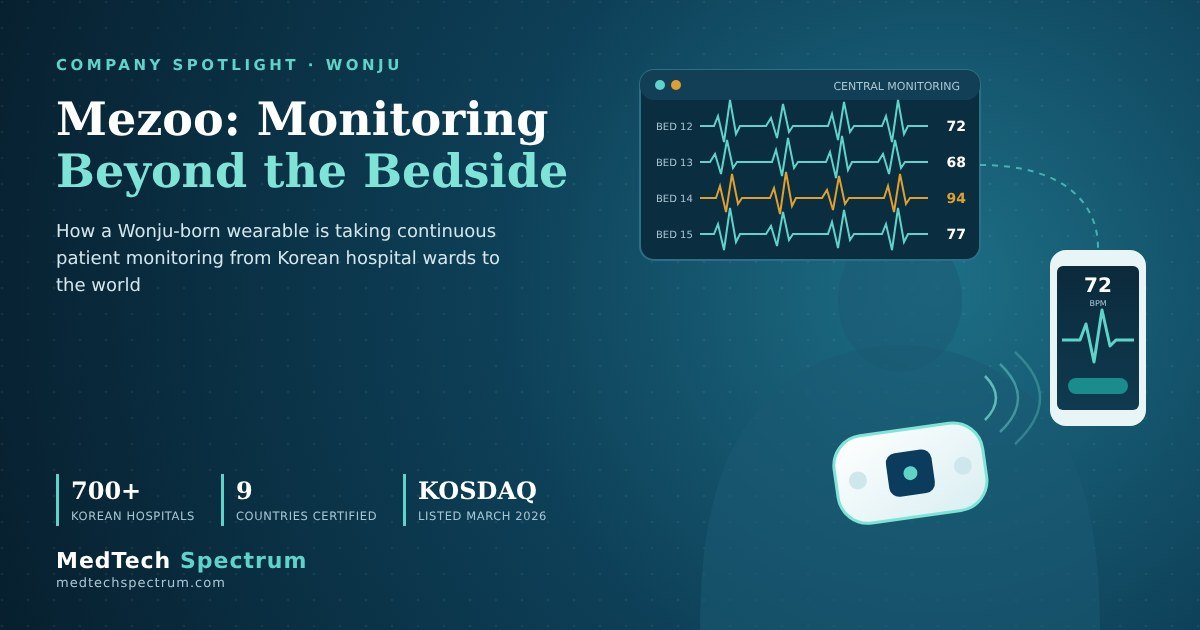
Mezoo at a glance Founded: 2007, by biomedical engineering PhDs from Yonsei University's Wonju campus Headquarters: Wonju, Gangwon State, South Korea CEO: Park Jung-hwan Platform: HiCardi, a wearable ambulatory remote patient monitoring (aRPM) system Home market: Used in more than 700 Korean hospitals and clinics, including about 53% of tertiary general hospitals Global reach: Medical device certifications in nine countries, including FDA, CE and ANVISA; sales partners in 17 countries Listing: KOSDAQ, March 2026 |
In most hospitals, continuous cardiac monitoring stops at the door of the intensive care unit. Patients on general wards, in emergency departments, on the move between departments or recovering at home after discharge are checked only periodically, even though many remain at risk. Mezoo estimates that Korea alone has around 600,000 hospital beds, yet only about 3% are covered by digital monitoring.
Mezoo calls its answer ambulatory remote patient monitoring, or aRPM: wearable technology that lets clinicians watch a patient's vital signs continuously, wherever that patient happens to be.
Mezoo was founded in 2007 by biomedical engineering PhDs from Yonsei University's Wonju campus, the academic engine that has fed talent and research into Wonju's medical device cluster for decades. The company keeps its core capabilities in-house: precision biosignal measurement, on-device machine learning for signal processing, product design and manufacturing. That vertical integration, Mezoo says, is what allows it to guarantee quality and reliability in a clinical setting.
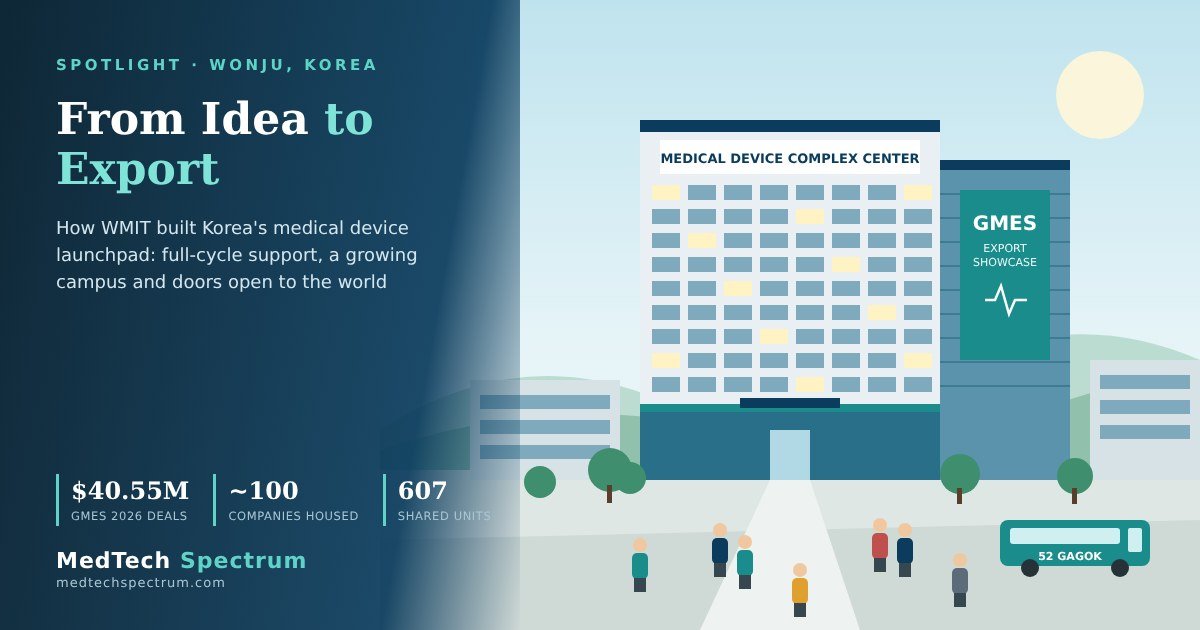
Its Wonju roots remain part of its growth story. In October 2026 Mezoo exhibited its wearable ECG patch in the joint pavilion that the Wonju Medical Industry Institute of Technology (WMIT) ran at Hospital Expo 2026 in Indonesia. There, six Korean companies held 44 business consultations worth USD 3.25 million and closed four contracts. For Mezoo, it is a clear example of how the Wonju ecosystem helps a homegrown innovator test new markets with the backing of a dedicated support institution.
At the centre of Mezoo's business is HiCardi, a wearable patch about half the size of a credit card that sits on the patient's chest. The patch analyses biosignals on the device in real time, so anomalies can be flagged immediately. A smartphone app relays the data, and central monitoring software lets hospital teams watch many patients at once. The patch also includes a defibrillation protection design, so it can stay in place if a patient needs to be defibrillated.
The product family has grown steadily, moving from single-channel ECG to multi-parameter monitoring.
|
Product |
What it does |
Status |
|
HiCardi+ H100 |
Single-lead wearable ECG recorder capturing continuous ECG and symptomatic events for up to 72 hours |
US FDA 510(k) clearance, September 2024 |
|
HiCardi+ |
Combines a patient monitor and a Holter monitor in one wearable, with respiration monitoring; described as a first of its kind in Korea |
MFDS approved; in use across Korean hospitals |
|
HiCardi M350 |
Multi-channel ECG, continuous heart rate, suspected arrhythmia detection and continuous body temperature, up to 48 hours per charge |
MFDS manufacturing approval, May 2026; preparing mass production |
|
Next generation |
Multi-parameter wearable adding SpO2, respiration, core temperature and continuous blood pressure |
Planned for staged release through 2026, subject to clinical trials and approvals |
CEO Park Jung-hwan has described the HiCardi M350 as a shift from ECG-focused devices towards a multi-parameter wearable patient monitor for hospitals, a step that widens the platform's role from cardiology to general patient safety.
Mezoo's domestic traction is the foundation of its global pitch. HiCardi is now used in more than 700 hospitals and clinics across Korea, including roughly 53% of the country's tertiary general hospitals. Much of that reach came within about three years of launch, through a strategic partnership with Dong-A ST, which is both an investor in Mezoo and the distribution partner for HiCardi across Korean hospitals.
Reimbursement has been just as important as distribution. Korean hospitals can bill national health insurance codes for bedside ECG monitoring and for remote cardiac monitoring when they use HiCardi, which turns continuous monitoring on general wards from a cost into a viable service. Mezoo earns recurring revenue through a subscription or fee-sharing model, priced at around KRW 30,000 per bed per month.
In March 2026 Mezoo listed on KOSDAQ, with Shinhan Investment Corp. as lead underwriter. The IPO priced at KRW 21,600, the top of its indicative range, and on debut day the shares briefly touched three times that price, a strong signal of investor confidence in the remote monitoring story.
The company has been clear about where the money is going: building distribution in North America and Europe, local sales and marketing, technology demonstrations and joint research with European tertiary hospitals, along with R&D in AI-based prediction and diagnosis and clinical trials for its next-generation products.
Mezoo already holds major medical device certifications in nine countries spanning the United States, Europe, South America, the Middle East and Southeast Asia, including FDA, CE and Brazil's ANVISA, and works with sales partners in 17 countries. The FDA clearance of HiCardi+ H100 in September 2024 opened the door to the world's largest medical device market.
The near-term priorities are concrete. For 2026, Mezoo has set out plans for proof-of-concept trials at major US hospitals and for securing a US CMS billing code, the reimbursement step that would make HiCardi commercially viable for American providers. Over the longer term, the company aims to win a 1 to 2% share of a global remote monitoring market it values at around USD 20 billion.
Southeast Asia offers a parallel path. The Indonesian pavilion with WMIT gave Mezoo direct access to local buyers and partners in one of the region's fastest-growing healthcare markets, complementing the larger push into North America and Europe.
Mezoo's own projections, set out around its listing, show the scale of its ambition. The company has forecast revenue of KRW 15.4 billion for 2026, a move into operating profit in 2027, and revenue of KRW 62.7 billion by 2029, driven by subscription income. These are company targets rather than results, but they rest on a model that investors tend to favour: recurring per-bed revenue, a large and under-penetrated installed base, and reimbursement already in place at home.
From a university lab in Wonju to hospital wards across Korea and a listing on KOSDAQ, Mezoo shows what a regional medical device cluster can produce when research, manufacturing, clinical adoption and export support line up. Its next chapter will be written in hospitals far from Gangwon.